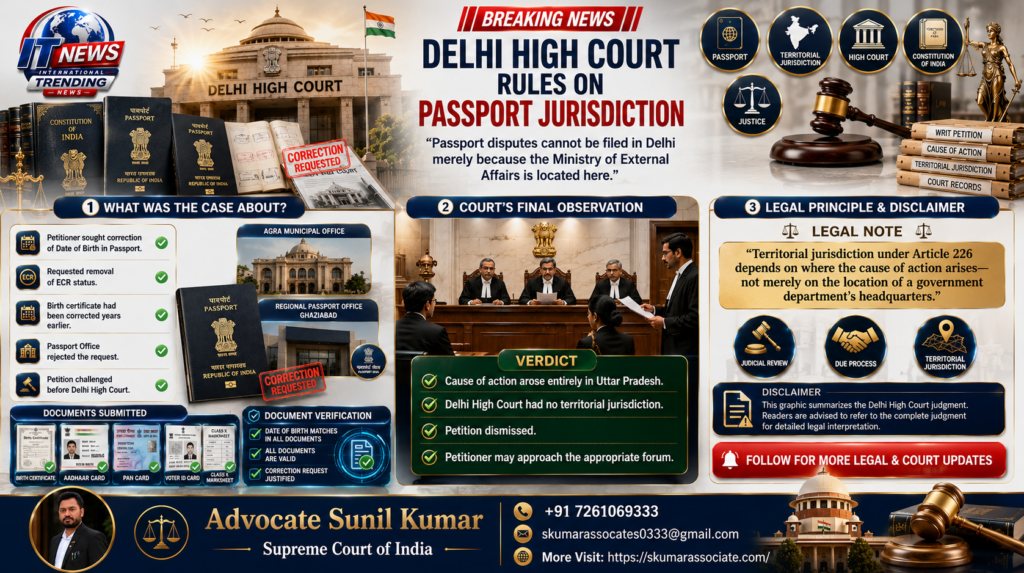
The Delhi High Court has delivered an important judgment clarifying the principles of territorial jurisdiction in passport-related disputes. The Court ruled that a writ petition concerning a passport issue cannot be filed before the Delhi High Court merely because the Ministry of External Affairs (MEA) is headquartered in New Delhi. Instead, jurisdiction under Article 226 of the Constitution of India depends on where the cause of action actually arises.
Background of the Case
The petitioner sought correction of the Date of Birth in his passport and requested the removal of the Emigration Check Required (ECR) status. According to the petitioner, the birth certificate issued by the Agra Municipal Corporation had originally contained an incorrect date of birth, which was officially corrected several years earlier.
Despite submitting the corrected Birth Certificate along with supporting documents such as the Aadhaar Card, PAN Card, Voter ID, and Class X Marksheet, the Regional Passport Office (RPO), Ghaziabad, rejected the request for correction. The petitioner subsequently approached the Delhi High Court seeking judicial intervention.
Observations of the Delhi High Court
The Court observed that every material event connected with the dispute had taken place in Uttar Pradesh. The Birth Certificate was issued and corrected in Agra, the passport was issued and renewed by the Regional Passport Office in Ghaziabad, and all relevant communications originated from authorities located in Uttar Pradesh.
The Bench emphasized that the mere presence of the Ministry of External Affairs’ headquarters in Delhi does not automatically give the Delhi High Court territorial jurisdiction over every passport-related matter. Relying on the Supreme Court’s landmark judgment in Kusum Ingots & Alloys Ltd. v. Union of India (2004), the Court reiterated that jurisdiction is determined by where the cause of action arises, not by the location of a government department’s headquarters.
Final Verdict
The Delhi High Court dismissed the writ petition for lack of territorial jurisdiction while granting the petitioner the liberty to approach the appropriate court or authority having jurisdiction over the matter. The judgment serves as a significant precedent for future passport and administrative law disputes, reaffirming that territorial jurisdiction under Article 226 is based on the factual cause of action rather than the administrative location of a government office.
Advocate Sunil Kumar
Supreme Court of India
📞 +91 7261069333
📧 [email protected]
🌐 https://skumarassociate.com/