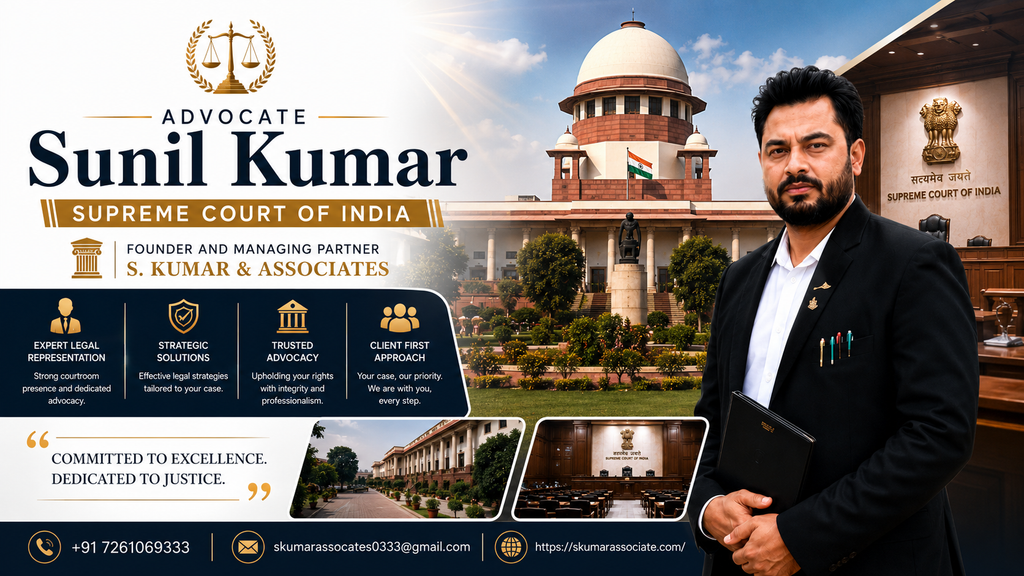
Advocate Sunil Kumar, Supreme Court of India (Ph. No. +91 7261069333), is the Founder & Managing Partner of S. Kumar & Associates and is associated with legal practice before the Supreme Court of India, the Delhi High Court, the Patna High Court, the Allahabad High Court, and District Courts across India.
For individuals searching for a Supreme Court Advocate in Noida, it is useful to understand how matters reach the Supreme Court, what appellate remedies may be available, and why proper legal documentation and procedure are important.
The Supreme Court of India is the country’s highest judicial court. It exercises different forms of jurisdiction, including appellate jurisdiction. Under Article 136 of the Constitution, the Court has discretionary power to grant special leave to appeal against judgments, decrees, determinations, sentences or orders passed by courts or tribunals, subject to the constitutional framework.
Understanding Supreme Court Appeals
Not every judgment or order automatically creates a right of appeal before the Supreme Court. The appropriate remedy depends upon the nature of the case, the court or tribunal that passed the order, the applicable legal provisions, jurisdiction, limitation, and the facts of the particular matter.
Supreme Court proceedings may include:
- Civil Appeals
- Criminal Appeals
- Special Leave Petitions (SLPs)
- Constitutional Matters
- Writ Petitions
- Review Petitions
- Curative Petitions
- Property and Land Matters
- Commercial Disputes
- Service Law Matters
- Family and Matrimonial Matters
A proper assessment of the judgment or order is therefore an important preliminary step before considering further proceedings.
Special Leave Petition (SLP)
A Special Leave Petition (SLP) under Article 136 is an important route for seeking the Supreme Court’s discretionary appellate jurisdiction. Article 136 does not create an automatic right of appeal; rather, the Court decides whether special leave should be granted. The Supreme Court has explained that Article 136 proceedings involve two stages: first, consideration of the request for special leave and, if leave is granted, consideration of the appeal itself.
This makes it important to examine the impugned judgment or order, possible legal grounds, relevant records, limitation, and maintainability before considering an SLP.
Civil and Property Appeals
Civil matters that may reach the Supreme Court can involve property disputes, land matters, contractual disputes, commercial transactions, inheritance, consumer issues, recovery proceedings, and other civil litigation.
The availability of a Supreme Court remedy depends on the applicable constitutional or statutory provisions. A person should therefore not assume that every adverse order from a lower court or High Court can automatically be taken to the Supreme Court.
Criminal Appeals and Liberty Matters
The Supreme Court also considers criminal appeals and matters concerning convictions, acquittals, sentencing, bail, and personal liberty.
In criminal proceedings, the judgment or order under challenge, procedural history, applicable statutory provisions, and legal grounds may all be relevant. The appropriate remedy must be assessed according to the facts and circumstances of the individual case.
Constitutional Matters
Constitutional questions form an important part of the Supreme Court’s work. Matters may involve interpretation of constitutional provisions, Fundamental Rights, legislative validity, jurisdictional issues and other significant questions of constitutional law.
Where a constitutional remedy is being considered, the specific facts and applicable constitutional provisions need to be examined carefully. The availability of a remedy cannot be determined simply by the nature or location of the litigant.
Importance of Documentation
Supreme Court proceedings involve specific procedural requirements. Depending upon the nature of a case, documents may include:
- Judgment or order being challenged
- Previous judgments and orders
- Pleadings and applications
- Affidavits
- Relevant annexures
- Supporting documents and records
- Vakalatnama and other filing documents
Maintaining a complete and properly organised case record can be important when preparing for an appellate or constitutional proceeding.
Limitation and Timely Action
Limitation is another important consideration in Supreme Court litigation. Different types of proceedings can have different limitation requirements, and the relevant period may depend on the nature of the proceeding and the applicable law.
For this reason, a person considering an appeal or SLP should have the relevant judgment or order examined promptly rather than waiting until the limitation period is close to expiry.
Digital Court Services
The Supreme Court has adopted digital systems and technology-based services to improve access to judicial information and court processes. E-filing, online case information, and electronic records have made several aspects of litigation more accessible.
For people based in Noida and the wider Delhi-NCR region, digital services can be useful for accessing information relating to Supreme Court proceedings while coordinating legal work from outside the Court premises.
Role of a Supreme Court Advocate in Noida
A Supreme Court Advocate in Noida may assist litigants in understanding the general legal and procedural framework applicable to Supreme Court matters. This can include examining the judgment or order, discussing possible legal remedies, understanding SLP proceedings, reviewing relevant documentation, and explaining procedural requirements.
However, legal strategy must always be based on the individual case. The appropriate remedy depends on the facts, applicable law, jurisdiction, limitations, and orders of the competent court.
About Advocate Sunil Kumar
Advocate Sunil Kumar, Founder & Managing Partner of S. Kumar & Associates, is associated with legal practice before the Supreme Court of India. The firm is also associated with legal matters before the Delhi High Court, Patna High Court, Allahabad High Court, and District Courts across India.
Individuals researching Supreme Court Advocate in Noida, Supreme Court Lawyer in Noida, Supreme Court Appeals, SLP Filing, Civil Appeals, Criminal Appeals or Constitutional Matters may seek professional legal guidance based on the specific facts and applicable law of their matter.
Conclusion
The Supreme Court plays a central role in India’s judicial and constitutional system. Understanding appeals, SLPs, constitutional proceedings, limitations, and documentation can help individuals become better informed before considering further legal action.
For someone searching for a Supreme Court Advocate in Noida, it is important to understand that every case requires an individual assessment. Whether the matter concerns property, civil litigation, criminal proceedings, commercial disputes, family matters, service law, or a constitutional question, the available legal remedy depends on the facts of the case, applicable law, and orders of the competent court.
Disclaimer
This content is intended solely for informational and educational purposes and should not be interpreted as legal advice, legal opinion, or solicitation. Any legal remedy before the Supreme Court depends on the facts of the case, the applicable law, and the orders of the competent court. Readers should obtain independent legal advice based on the specific facts and circumstances of their case before taking any legal action.