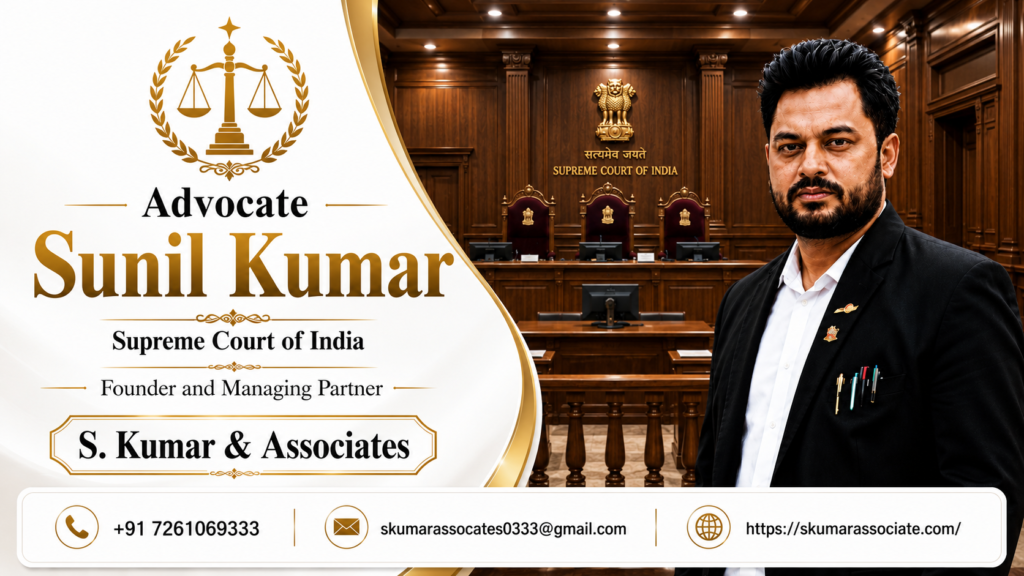
Advocate Sunil Kumar, Supreme Court of India (Ph. No. +91 7261069333), is the Founder & Managing Partner of S. Kumar & Associates and is associated with legal practice before the Supreme Court of India, Delhi High Court, Patna High Court, Allahabad High Court, and District Courts across India.
For individuals searching for a Supreme Court Advocate in Noida, it is important to understand how matters reach the Supreme Court, what types of appeals may be available, and why proper legal procedure and documentation are important. The Supreme Court has original, appellate, and advisory jurisdiction and also has constitutional jurisdiction for the enforcement of Fundamental Rights.
Understanding Supreme Court Appeals
The Supreme Court of India is the highest court in the country’s judicial system. However, every judgment or order does not automatically create a right of appeal before the Supreme Court. The availability of a particular remedy depends on the nature of the case, applicable law, jurisdiction, and the judgment or order being challenged.
Supreme Court proceedings can include:
- Civil Appeals
- Criminal Appeals
- Special Leave Petitions (SLPs)
- Constitutional Matters
- Writ Petitions
- Review Petitions
- Curative Petitions
- Property and Land Matters
- Commercial Disputes
- Service Law Matters
- Family and Matrimonial Matters
The Supreme Court’s official jurisdiction information explains the various constitutional and appellate routes through which matters can come before the Court.
What Is a Special Leave Petition?
A Special Leave Petition (SLP) is a constitutional mechanism under Article 136 of the Constitution of India. Under this provision, the Supreme Court may, in its discretion, grant special leave to appeal against a judgment, decree, determination, sentence, or order passed by a court or tribunal.
An SLP is not an automatic right of appeal. The Supreme Court exercises discretionary jurisdiction under Article 136, and the question of whether special leave should be granted depends upon the circumstances and legal issues involved in the matter.
Therefore, before considering an SLP, it is important to examine the judgment or order, possible legal grounds, limitation requirements, relevant records, and maintainability.
Civil and Criminal Appeals
Civil appeals before the Supreme Court may involve matters relating to property, land, contracts, commercial disputes, inheritance, consumer matters, recovery proceedings, and other civil issues.
Criminal proceedings may involve appeals concerning convictions, acquittals, sentencing, bail, personal liberty, and significant questions of criminal law. The appropriate remedy depends upon the specific facts, procedural history, and applicable statutory provisions.
A legal matter should therefore be evaluated individually rather than assuming that a particular type of dispute will automatically be accepted by the Supreme Court.
Constitutional Matters and Fundamental Rights
Constitutional matters are an important part of the Supreme Court’s jurisdiction. Under Article 32, the Court can issue appropriate directions, orders, or writs for enforcement of Fundamental Rights, including writs in the nature of habeas corpus, mandamus, prohibition, quo warranto, and certiorari.
Constitutional proceedings may involve questions concerning Fundamental Rights, interpretation of constitutional provisions, legislative validity, jurisdictional issues, and other significant questions of constitutional law.
Whether a constitutional remedy is appropriate depends upon the facts of the particular matter and the applicable legal framework.
Importance of Legal Documents
Proper documentation is an important part of Supreme Court proceedings. Depending upon the nature of the matter, relevant records may include judgments and orders, pleadings, affidavits, annexures, vakalatnama, and other supporting documents.
The Supreme Court also provides various procedural applications and filing-related facilities, including applications concerning SLPs, writ petitions, appeals, delay, and other procedural matters.
Limitation is another important consideration. Since different proceedings may have different limitation requirements, a judgment or order should be examined promptly before deciding whether further legal proceedings are appropriate.
Digital Court Services
Technology has become an important part of modern judicial administration. E-filing, electronic records, online case information, and other digital services have made several court-related processes more accessible to litigants and legal professionals.
For individuals based in Noida and the wider Delhi-NCR region, digital court facilities can be useful for accessing information relating to Supreme Court proceedings without being physically present in Delhi for every administrative requirement.
Role of a Supreme Court Advocate in Noida
A Supreme Court Advocate in Noida may assist individuals in understanding the legal framework associated with Supreme Court proceedings, including appeals, SLPs, constitutional matters, documentation, and procedural requirements.
However, the appropriate legal remedy depends upon the individual case. A person’s location in Noida alone does not determine whether a matter can be taken before the Supreme Court. The judgment or order, applicable law, jurisdiction, limitation, and facts of the matter must be considered.
About Advocate Sunil Kumar
Advocate Sunil Kumar, Founder & Managing Partner of S. Kumar & Associates, is associated with legal practice before the Supreme Court of India. The firm is also associated with legal matters before various High Courts and District Courts across India.
Individuals researching Supreme Court Advocate in Noida, Supreme Court Lawyer in Noida, Supreme Court Appeals, SLP Filing, Civil Appeals, Criminal Appeals, or Constitutional Matters may seek professional legal guidance to understand the legal framework applicable to their specific circumstances.
Conclusion
Understanding Supreme Court jurisdiction, appeals, Special Leave Petitions, and constitutional remedies can help individuals become better informed before considering further legal action. Whether a matter concerns a civil dispute, criminal proceeding, property issue, commercial dispute, family matter, service dispute, or constitutional question, the available legal remedy depends on the specific facts, applicable law, and orders of the competent court.
For individuals searching for a Supreme Court Advocate in Noida, a proper assessment of the available remedy, limitation, documentation, and procedural requirements can be an important first step in understanding the Supreme Court litigation process.
Disclaimer
This content is intended solely for informational and educational purposes and should not be interpreted as legal advice, legal opinion, or solicitation. Any legal remedy before the Supreme Court depends on the facts of the case, the applicable law, and the orders of the competent court. Readers should obtain independent legal advice based on the specific facts and circumstances of their case before taking any legal action.