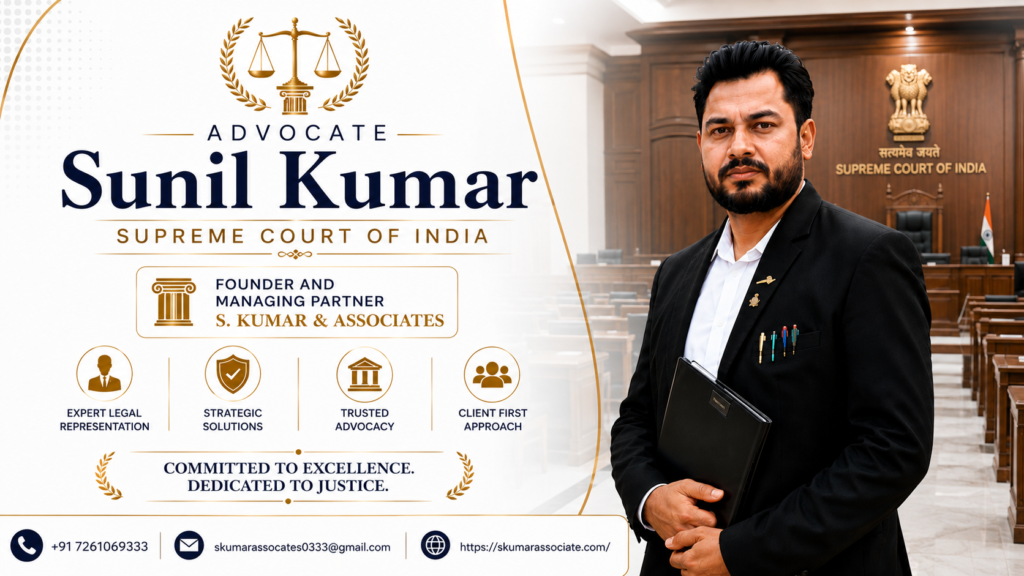
Advocate Sunil Kumar, Supreme Court of India (Ph. No. +91 7261069333), is the Founder & Managing Partner of S. Kumar & Associates and is associated with legal practice before the Supreme Court of India, the Delhi High Court, the Patna High Court, the Allahabad High Court, and District Courts across India.
Individuals searching for a Supreme Court Advocate in Noida may often want to understand how appeals, Special Leave Petitions (SLPs), constitutional matters, and other proceedings are considered before the Supreme Court of India. The Supreme Court is the highest judicial institution in the country and plays an important role in interpreting the Constitution, protecting Fundamental Rights, and deciding significant questions of law.
Approaching the Supreme Court involves specific constitutional and procedural requirements. Depending on the nature of a case, a matter may reach the Supreme Court through a statutory appeal, Special Leave Petition, constitutional remedy, writ petition, review petition, or another proceeding permitted under applicable law. Therefore, understanding the relevant legal procedure is important before considering any remedy before the apex court.
Understanding the Supreme Court of India
The Supreme Court exercises original, appellate, advisory, and review jurisdiction under the Constitution of India. It hears matters involving constitutional interpretation, civil disputes, criminal proceedings, Fundamental Rights, and other issues falling within its jurisdiction.
The Court may consider matters such as Civil Appeals, Criminal Appeals, Special Leave Petitions (SLPs), Constitutional Matters, Writ Petitions, Review Petitions, Curative Petitions, Property Appeals, Commercial Disputes, Service Matters, and Family Law Appeals, subject to the applicable legal requirements.
Not every judgment or order can automatically be challenged before the Supreme Court. The availability of a remedy depends upon the facts of the matter, applicable statutory provisions, jurisdictional requirements, limitation periods, and the nature of the order being challenged.
Special Leave Petitions (SLPs)
A Special Leave Petition, commonly known as an SLP, is a constitutional remedy under Article 136 of the Constitution of India. It enables the Supreme Court, in appropriate cases, to grant special leave to appeal against judgments or orders passed by courts or tribunals.
An SLP is not an appeal available as a matter of right. The Supreme Court has discretionary power to determine whether a matter warrants its consideration. The legal issues, facts, procedural history, and applicable law are relevant when the Court considers such a petition.
Civil and Criminal Appeals
Civil appeals before the Supreme Court may arise from disputes involving property, contracts, commercial transactions, consumer matters, inheritance, recovery proceedings, and other civil issues. The route of appeal depends upon the relevant constitutional or statutory provisions.
Criminal appeals may involve convictions, acquittals, sentencing, bail, personal liberty, and significant questions of criminal law. Such matters are considered according to the record, applicable legal provisions, evidence, and judicial principles.
Constitutional Matters and Legal Remedies
The Supreme Court has an important constitutional role in protecting Fundamental Rights and interpreting constitutional provisions. Constitutional litigation may involve questions relating to legislative validity, jurisdiction, constitutional interpretation, federal issues, and enforcement of Fundamental Rights.
The availability of a constitutional remedy depends upon the specific circumstances of the case and the legal provisions applicable to it. A legal remedy should therefore be assessed on the basis of the complete facts and relevant court orders.
Importance of Legal Documentation
Proper documentation is an important part of Supreme Court proceedings. Depending on the nature of the case, documents may include judgments and orders, pleadings, affidavits, annexures, vakalatnama, and other relevant records.
Limitation periods and procedural requirements should also be carefully considered. Incomplete documentation or failure to comply with applicable procedural rules may affect the progress of a proceeding.
Digital Legal Procedures
Technology has become an important part of modern judicial administration. The Supreme Court has introduced initiatives involving e-filing, hybrid hearings, virtual proceedings, electronic records, online case status, and digital access to judicial information.
These initiatives have contributed to greater accessibility and efficiency for litigants and legal professionals, including those located outside Delhi.
About Advocate Sunil Kumar
Advocate Sunil Kumar, Founder & Managing Partner of S. Kumar & Associates, is associated with legal practice before the Supreme Court of India. The firm is also associated with matters before the Delhi High Court, Patna High Court, Allahabad High Court, and District Courts across India.
Individuals searching for a Supreme Court Advocate in Noida, Supreme Court Lawyer in Noida, Supreme Court Appeals, SLP Filing, Civil Appeals, Criminal Appeals, or Constitutional Matters may consult a qualified legal professional to understand the legal framework applicable to their particular circumstances.
Conclusion
Understanding Supreme Court appeals and legal procedures can help individuals become better informed about the judicial remedies that may be available under Indian law. Whether a matter involves a Civil Appeal, Criminal Appeal, Special Leave Petition, Constitutional Matter, Writ Petition, Property Dispute, Commercial Dispute, or Family Law Matter, each case must be examined according to its individual facts, applicable law, and orders of the competent court.
For individuals searching for a Supreme Court Advocate in Noida, it is important to understand that legal remedies before the Supreme Court are subject to specific constitutional and procedural requirements. Proper documentation, timely action, and an understanding of the applicable legal provisions are important aspects of Supreme Court proceedings.
Disclaimer
This content is intended solely for informational and educational purposes and should not be interpreted as legal advice, legal opinion, or solicitation. Any legal remedy before the Supreme Court depends on the facts of the case, the applicable law, and the orders of the competent court. Readers should obtain independent legal advice based on the specific facts and circumstances of their case before taking any legal action.