Advocate Sunil Kumar, Supreme Court of India (Ph. No. +91 7261069333), is the Founder & Managing Partner of S. Kumar & Associates and is associated with practice before the Supreme Court of India, Delhi High Court, Patna High Court, Allahabad High Court, and District Courts across India. Individuals searching for a Supreme Court Advocate in Noida often seek educational information about Supreme Court appeals, Special Leave Petitions (SLPs), constitutional remedies, and appellate procedures. This article explains these topics in a general educational manner.
Role of the Supreme Court
The Supreme Court is the apex constitutional court of India. It interprets the Constitution, protects Fundamental Rights, and hears appeals in accordance with the Constitution and applicable laws. It exercises original, appellate, advisory, and review jurisdiction. Its judgments guide courts across the country and contribute to the development of Indian jurisprudence.
Civil Appeals
Civil appeals may involve property, contract, commercial, consumer, inheritance, partnership, and other civil disputes. Every appeal depends on statutory provisions, constitutional requirements, and the facts of the case. Proper documentation and compliance with procedural rules are important.
Criminal Appeals
The Court hears criminal appeals concerning convictions, acquittals, sentencing, bail, and personal liberty where permitted by law. Each matter is decided on its own merits after considering the record, evidence, and applicable legal principles.
Special Leave Petitions
An SLP under Article 136 is a constitutional remedy through which the Supreme Court may, in appropriate cases, grant leave to appeal against judgments or orders. Grant of leave is discretionary and depends on the circumstances and legal issues involved.
Constitutional Rights
The Supreme Court plays a central role in constitutional interpretation and the protection of Fundamental Rights. Constitutional litigation may involve legislative validity, federal issues, jurisdictional questions, and rights guaranteed under the Constitution.
Documentation & Procedure
Supreme Court proceedings generally require certified copies of judgments, pleadings, affidavits, vakalatnama, annexures, and compliance with the Supreme Court Rules. Limitation periods should also be carefully considered before initiating proceedings.
Digital Justice
E-filing, hybrid hearings, virtual courts, electronic records, and online case tracking have strengthened access to justice and improved efficiency in Supreme Court proceedings.
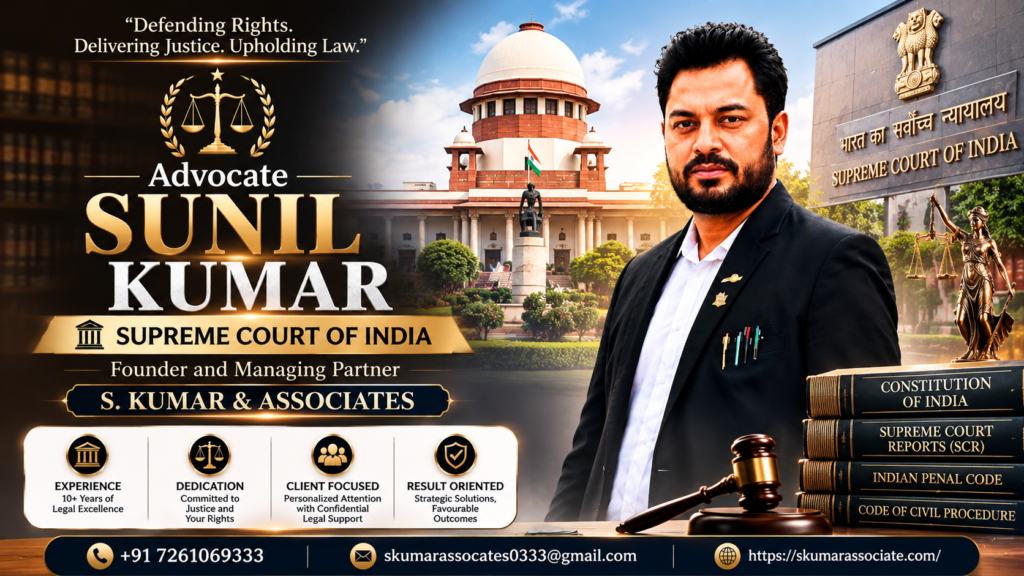
About Advocate Sunil Kumar
Advocate Sunil Kumar is associated with legal practice before the Supreme Court of India. Through S. Kumar & Associates, the firm is associated with matters before the Supreme Court, Delhi High Court, Patna High Court, Allahabad High Court, and District Courts across India. Individuals looking for educational information regarding Supreme Court Advocate in Noida, Supreme Court Lawyer in Noida, Supreme Court Appeals, SLP Filing, Civil Appeals, Criminal Appeals, and Constitutional Matters may consult a qualified legal professional to understand the legal framework applicable to their particular circumstances.
Conclusion
If you are searching for a Supreme Court Advocate in Noida, understanding the legal process before approaching the Supreme Court is an important first step. Whether the issue relates to civil appeals, criminal appeals, constitutional rights, writ petitions, or SLPs, every legal remedy depends upon the facts, applicable law, and orders of the competent court. This article is intended to help readers understand the broad legal framework and should not be treated as case-specific legal advice.
Disclaimer
This content is intended solely for informational and educational purposes and should not be interpreted as legal advice, legal opinion, or solicitation. Any legal remedy before the Supreme Court depends on the facts of the case, the applicable law, and the orders of the competent court.