The Supreme Court of India is the highest constitutional court in the country and serves as the final authority for interpreting the Constitution, protecting fundamental rights, and resolving significant legal disputes. Every year, thousands of litigants approach the Supreme Court through appeals, Special Leave Petitions (SLPs), constitutional petitions, review petitions, and other proceedings arising from decisions of High Courts and other judicial forums.
If you are searching for a Supreme Court Advocate in Patna, it is important to understand how matters reach the Supreme Court, what types of cases are maintainable before the Court, and the procedural requirements involved in filing a case. Supreme Court litigation follows specific statutory provisions, constitutional principles, and procedural rules that differ from proceedings before District Courts and High Courts.
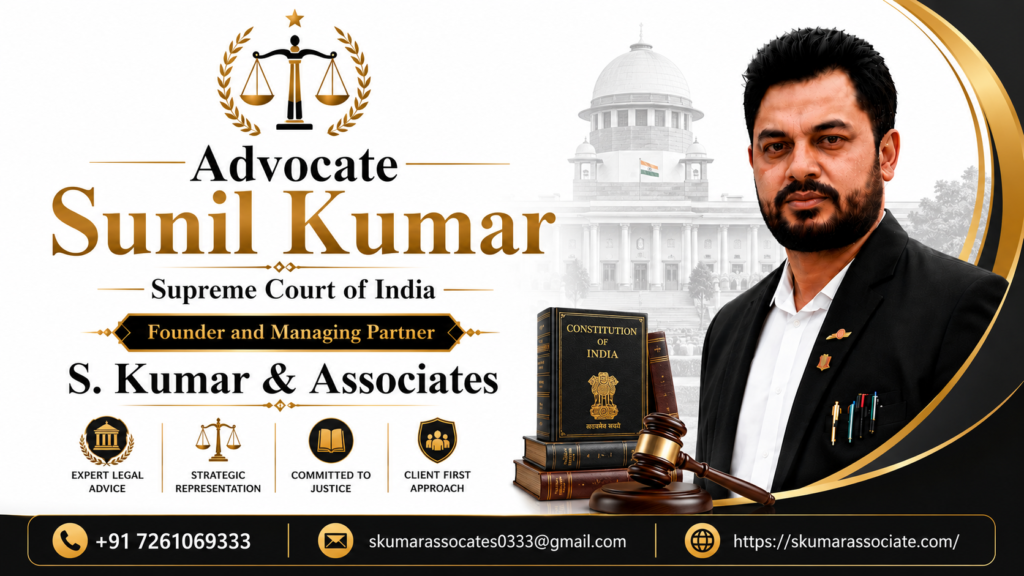
Advocate Sunil Kumar, Founder & Managing Partner of S. Kumar & Associates, is associated with legal practice before the Supreme Court of India and also represents clients before the Patna High Court, Delhi High Court, Allahabad High Court, and courts across India. Individuals seeking information regarding Supreme Court procedures, appellate remedies, and documentation may benefit from understanding the legal framework governing proceedings before India’s apex court.
Understanding the Role of the Supreme Court of India
The Supreme Court exercises original, appellate, advisory, and review jurisdiction under the Constitution of India. It decides matters involving constitutional interpretation, disputes between governments, appeals from High Courts, and cases raising substantial questions of law of general public importance.
The Court also safeguards the Fundamental Rights guaranteed under the Constitution and has the authority to issue appropriate constitutional remedies in suitable cases. Through its judgments, the Supreme Court plays an essential role in shaping Indian jurisprudence and ensuring uniform interpretation of laws throughout the country.
When Can a Matter Reach the Supreme Court?
Not every legal dispute is directly filed before the Supreme Court. Depending upon the facts and applicable legal provisions, a matter may reach the Supreme Court in different ways.
Some common routes include:
- Special Leave Petition (SLP) under Article 136 of the Constitution.
- Civil Appeals arising from High Court judgments.
- Criminal Appeals.
- Constitutional Writ Petitions.
- Appeals involving substantial questions of constitutional interpretation.
- Review Petitions.
- Curative Petitions in exceptional circumstances.
- Public Interest Litigations (PILs), where maintainable.
- Election and constitutional matters falling within the Court’s jurisdiction.
Every proceeding is governed by specific legal requirements, limitation periods, documentation standards, and procedural rules.
Common Matters Handled Before the Supreme Court
The Supreme Court hears a wide variety of disputes involving individuals, companies, institutions, and governments. Some commonly encountered categories include:
Special Leave Petitions (SLPs)
One of the most common remedies before the Supreme Court is a Special Leave Petition, which enables the Court to examine decisions passed by High Courts or tribunals where exceptional circumstances justify interference.
Civil Appeals
Civil appeals may arise from disputes involving contracts, property, succession, partnership matters, recovery proceedings, injunctions, commercial litigation, and other civil issues.
Criminal Appeals
The Supreme Court hears criminal appeals involving convictions, acquittals, bail matters, sentencing issues, criminal procedure, and important questions relating to criminal jurisprudence.
Constitutional Matters
Cases involving interpretation of constitutional provisions, legislative validity, fundamental rights, federal disputes, and constitutional governance frequently come before the Supreme Court.
Writ Petitions
In appropriate circumstances, constitutional remedies may be sought through writ petitions concerning violation of fundamental rights or other constitutional issues.
Bail and Personal Liberty Matters
The Court regularly hears matters concerning bail, personal liberty, illegal detention, and constitutional protections guaranteed under Article 21 of the Constitution.
Property and Land Disputes
Appeals involving ownership, title disputes, acquisition matters, partition, possession, easement rights, and other property-related litigation may ultimately reach the Supreme Court after decisions of subordinate courts and High Courts.
Family and Matrimonial Appeals
Certain matrimonial disputes involving divorce, maintenance, child custody, guardianship, matrimonial transfers, and related family law issues may also be considered by the Supreme Court depending upon the procedural stage and applicable law.
Commercial and Consumer Matters
Commercial litigation involving arbitration, company law, insolvency, banking disputes, consumer disputes, and contractual interpretation often reaches the Supreme Court through appellate proceedings.
Importance of Proper Documentation
One of the most significant aspects of Supreme Court litigation is maintaining complete and accurate documentation. Missing records or incomplete filings may affect procedural compliance.
Typical documents may include:
- Certified copies of judgments and orders.
- Pleadings filed before lower courts.
- Annexures and documentary evidence.
- Affidavits.
- Court fee documents.
- Vakalatnama.
- Indexing and paper books.
- Relevant statutory materials.
- Previous interim orders.
The exact documentation depends upon the nature of the proceedings and the applicable Supreme Court Rules.
Limitation Periods Matter
Supreme Court proceedings are governed by limitation periods prescribed under applicable law. Delay in filing may require a separate application explaining the reasons for delay, and condonation is subject to judicial consideration.
Accordingly, individuals considering appellate remedies should remain aware of statutory timelines and preserve all relevant court records immediately after receiving a judgment or order.
Digital Transformation in the Supreme Court
The Supreme Court of India has significantly modernized judicial administration through technology-driven initiatives.
Recent developments include:
- E-filing of cases.
- Hybrid hearings.
- Virtual court proceedings.
- Electronic case records.
- Digital access to cause lists.
- Online case status tracking.
- Video conferencing facilities.
- Improved judicial information systems.
These initiatives have enhanced accessibility and streamlined judicial procedures while promoting greater efficiency in case management.
Why Understanding Supreme Court Procedure Is Important
Proceedings before the Supreme Court involve specialized procedural requirements that differ from litigation before subordinate courts. Understanding these procedures helps litigants appreciate the importance of limitation periods, jurisdictional requirements, documentation, court rules, and appellate practice.
Every case is unique. Whether a matter is maintainable before the Supreme Court depends upon the specific facts, applicable statutes, constitutional provisions, and the orders passed by the competent courts.
About Advocate Sunil Kumar
Advocate Sunil Kumar is the Founder & Managing Partner of S. Kumar & Associates and is associated with legal practice before the Supreme Court of India. The firm also provides legal representation before the Patna High Court, Delhi High Court, Allahabad High Court, and District Courts across India.
Individuals seeking information regarding Supreme Court procedures, appellate remedies, constitutional litigation, filing requirements, and documentation may consult legal professionals for guidance based on the facts of their individual cases and the applicable legal framework.
Contact Information
Advocate Sunil Kumar
Founder & Managing Partner – S. Kumar & Associates
Mobile: +91 7261069333
Email: [email protected]
Website: https://skumarassociate.com/lawyers-in-patna
Conclusion
The Supreme Court of India occupies a central position in the Indian judicial system by interpreting the Constitution, safeguarding fundamental rights, and resolving significant legal disputes. Appeals before the Supreme Court require careful adherence to procedural rules, statutory limitation periods, and comprehensive documentation.
Whether a matter concerns constitutional law, civil appeals, criminal appeals, Special Leave Petitions, property disputes, matrimonial litigation, commercial matters, or public interest issues, understanding the legal process is essential before pursuing any remedy before the apex court. Awareness of jurisdictional requirements and procedural compliance enables litigants to make informed decisions regarding available legal remedies under Indian law.
Disclaimer
This content is intended solely for informational and educational purposes and should not be interpreted as legal advice, legal opinion, or solicitation. Any legal remedy before the Supreme Court depends on the facts of the case, the applicable law, and the orders of the competent court. Readers should obtain independent legal advice based on the specific facts and circumstances of their individual cases before taking any legal action.