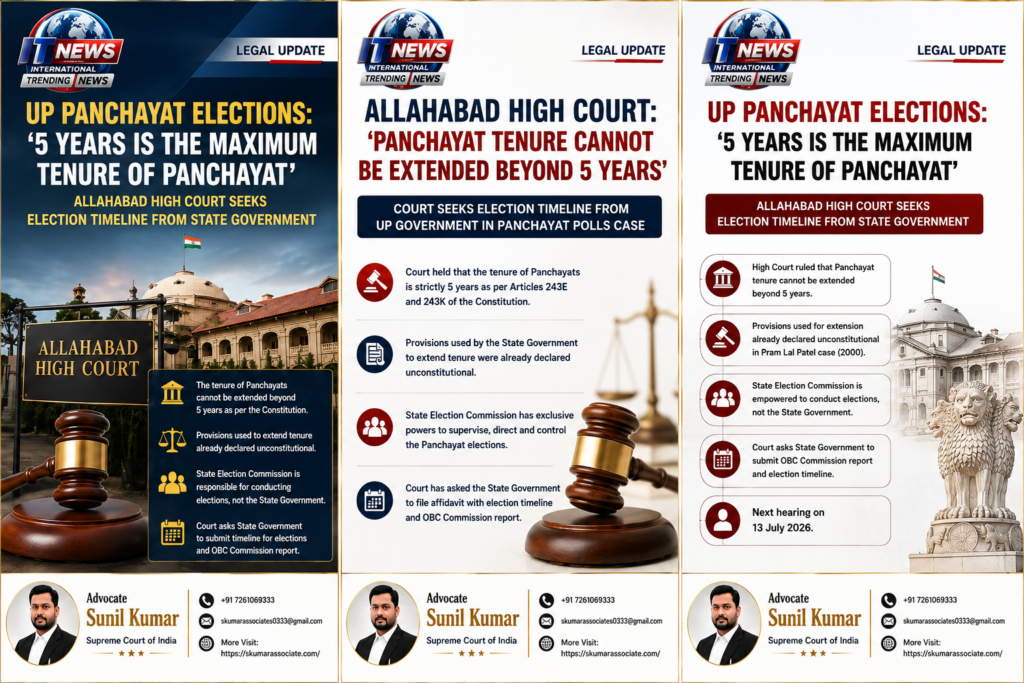
The Allahabad High Court has made a significant observation regarding the delay in the Uttar Pradesh Panchayat Elections, emphasizing that the tenure of a Panchayat cannot be extended beyond five years as mandated by the Constitution of India. The Court also directed the Uttar Pradesh Government to submit a clear timeline for conducting the long-pending Panchayat elections.
High Court’s Constitutional Observation
While hearing the petition Arvind Rathore vs. State of Uttar Pradesh & Others, Justice Siddharth Nandan observed that Article 243E of the Constitution clearly provides that the tenure of every Panchayat shall be five years and no longer. The Constitution also requires that elections for the next Panchayat must be completed before the expiry of the existing Panchayat’s term.
The Court further noted that the provisions relied upon by the State Government to extend the tenure of Gram Pradhans had already been declared unconstitutional by the Allahabad High Court in the landmark case Pram Lal Patel vs. State of U.P. (2000). Therefore, the recent government orders extending the tenure of Panchayat representatives appear to be legally non-existent (non est).
State Election Commission’s Role
The Court reiterated that Article 243K vests the exclusive power of conducting Panchayat elections in the State Election Commission. The State Government cannot interfere with this constitutional authority or postpone elections through executive orders.
During the hearing, the State Election Commission informed the Court that the electoral rolls had already been published on 10 June 2026 and that it was fully prepared to conduct the elections. However, it stated that the process could not proceed because the State Government had not provided the necessary administrative arrangements.
Government’s Stand
The Uttar Pradesh Government submitted that the delay was due to the pending report of the OBC Reservation Commission. However, the High Court observed that such reasons cannot justify extending the constitutional tenure of Panchayats beyond five years.
The Court also held that Gram Pradhans cannot continue as administrators after the expiry of their constitutional term. It directed the State Government to file an affidavit specifying the status of the OBC Commission’s report and providing a definite election schedule.
Court Seeks Accountability
The High Court has also asked the concerned government official to explain why fresh orders were issued based on a statutory provision that had already been declared unconstitutional. The Court observed that failure to provide a satisfactory explanation could amount to prima facie contempt of the earlier Division Bench judgment.
The matter is scheduled for its next hearing on 13 July 2026.
Why This Judgment Matters
This case reinforces the constitutional principle that democratic institutions must function within the time limits prescribed by law. The judgment underlines that local self-government cannot be weakened by indefinite extensions of elected bodies and that timely elections are an essential part of India’s democratic framework.
Advocate Sunil Kumar
Supreme Court of India
Founder & Managing Partner, S. Kumar & Associates
📞 +91 7261069333
📧 [email protected]
🌐 https://skumarassociate.com/