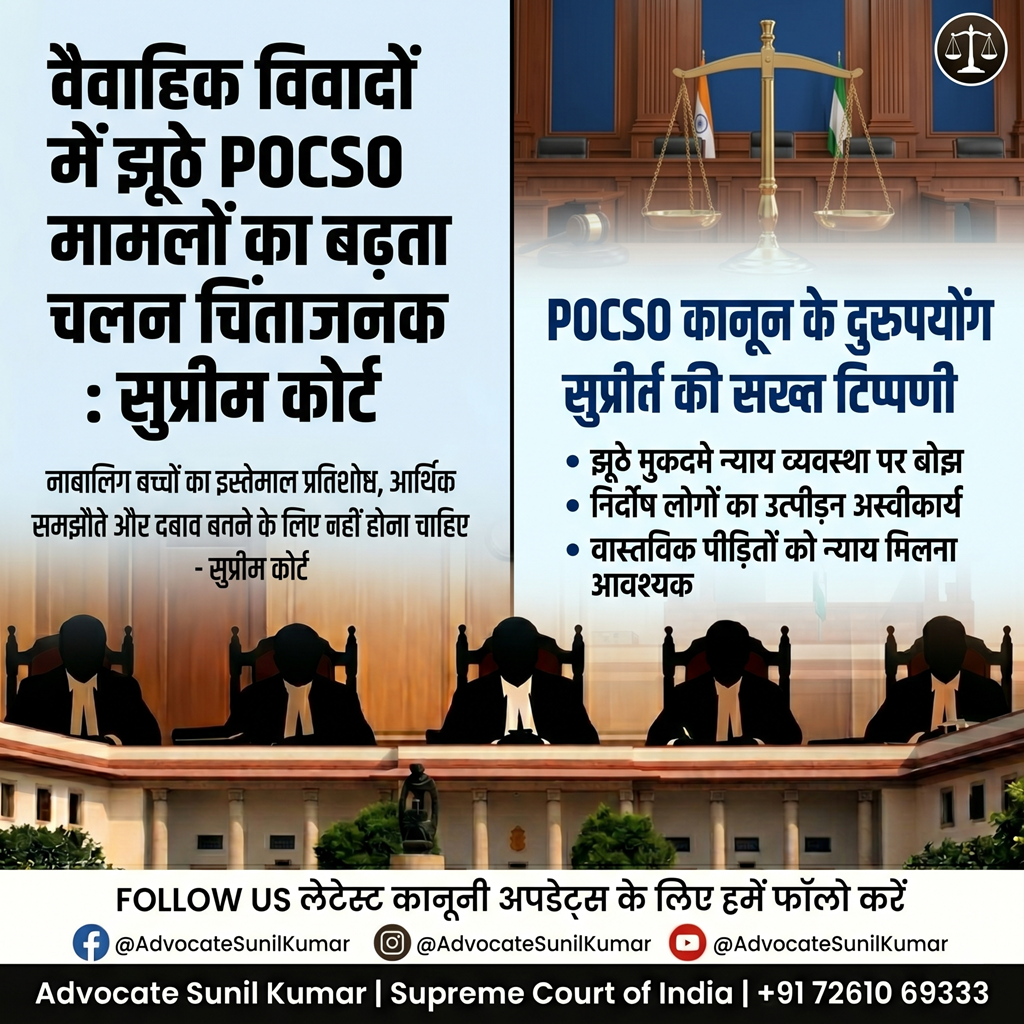
The Supreme Court of India has recently expressed serious concern over the increasing misuse of the Protection of Children from Sexual Offences (POCSO) Act in matrimonial disputes. The Court observed that in certain cases, criminal proceedings are initiated not to seek justice but to gain leverage in family conflicts, secure higher financial settlements, or exert pressure on the opposing party.
Such misuse not only affects innocent individuals and their families but also places an unnecessary burden on the criminal justice system.
The Supreme Court’s Observations
While hearing a case involving multiple criminal allegations, including charges under the POCSO Act and rape provisions, a bench comprising Justice B.V. Nagarathna and Justice Ujjal Bhuyan quashed more than ten criminal cases filed against a husband and his family members. The Court found the allegations to be vague, unsupported by credible evidence, and lacking the necessary legal foundation.
The bench highlighted a disturbing pattern where minor children, particularly daughters, are sometimes drawn into matrimonial conflicts and used as instruments of retaliation. According to the Court, such practices can have long-term psychological and emotional consequences for children.
Understanding the Purpose of the POCSO Act
The POCSO Act was enacted to provide robust legal protection to children against sexual offences and to ensure speedy justice for victims. It remains one of the most important child-protection laws in India.
However, the effectiveness of any law depends on its responsible and genuine use. When serious criminal statutes are invoked for ulterior motives, the integrity of the legal system is compromised.
Consequences of False POCSO Allegations
1. Harm to Innocent Individuals
Allegations under the POCSO Act carry severe social and legal consequences. Even before a trial concludes, the accused may suffer irreparable damage to their reputation, career, and personal relationships.
2. Burden on the Justice System
False cases consume valuable judicial time and investigative resources that could otherwise be dedicated to genuine victims seeking justice.
3. Impact on Genuine Victims
The misuse of protective laws may create skepticism within society, potentially making it more difficult for actual victims of abuse to be heard, believed, and protected.
4. Emotional Impact on Children
When children become part of legal battles between parents, they may experience significant emotional distress, anxiety, and long-term psychological harm.
The Need for Careful Scrutiny
The Supreme Court emphasized that lawyers, investigating agencies, and courts must carefully examine allegations at the initial stage. Frivolous or baseless complaints should not automatically result in prolonged criminal proceedings.
A balanced approach is necessary—one that protects genuine victims while safeguarding innocent individuals from malicious prosecution.
Balancing Justice and Protection
The Court made it clear that concerns about misuse should never dilute the seriousness of actual cases of child sexual abuse or matrimonial cruelty. Genuine victims deserve the full protection of the law, and offenders must be prosecuted rigorously.
At the same time, legal safeguards must ensure that criminal laws are not weaponized in personal disputes.
Conclusion
The Supreme Court’s observations serve as an important reminder that the rule of law depends not only on strong legislation but also on its fair and responsible application. The misuse of the POCSO Act or any criminal law undermines public confidence in the justice system and can cause immense hardship to innocent individuals.
The challenge before the legal system is to strike the right balance—protecting genuine victims while preventing the misuse of powerful legal provisions. Only through careful scrutiny, impartial investigation, and judicial vigilance can justice truly be served.
Author: Advocate Sunil Kumar
Supreme Court of India
Contact: +91 72610 69333