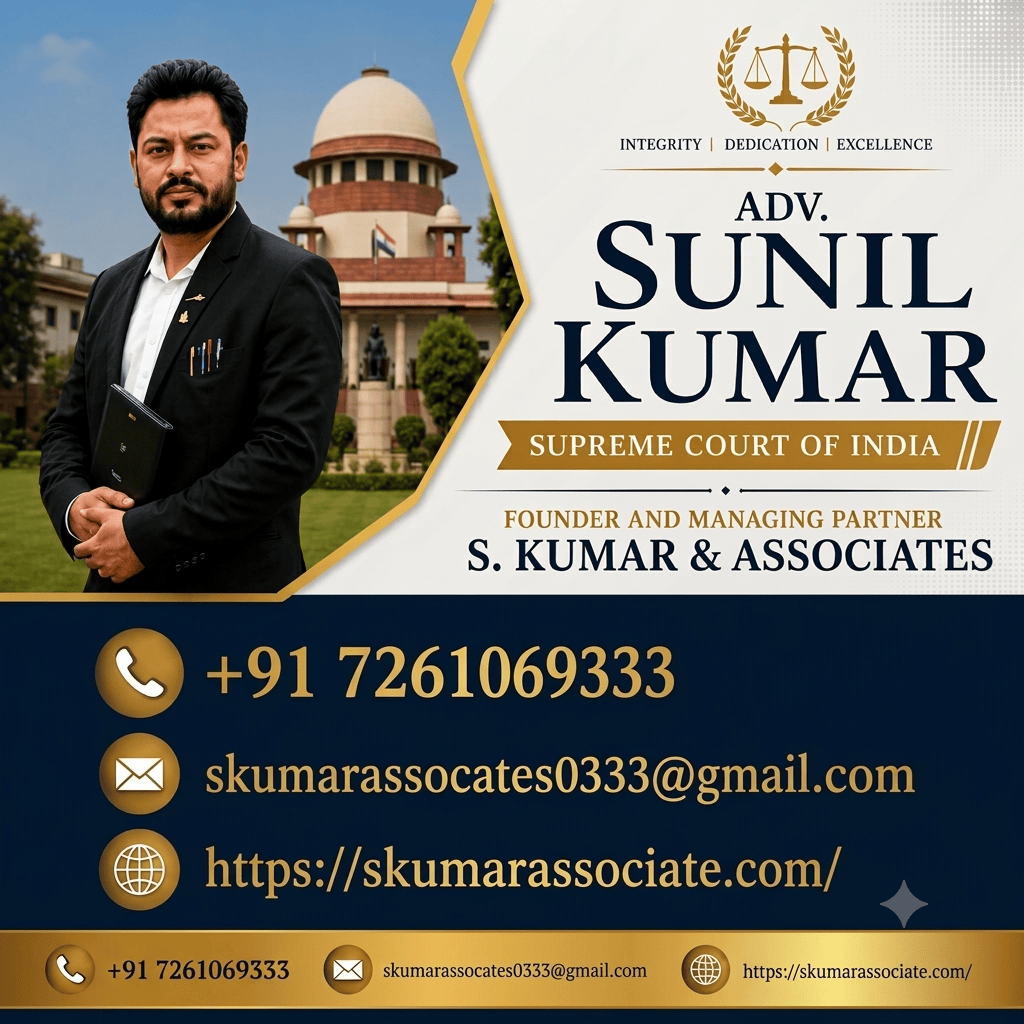
Advocate in Sector 32, Greater Noida for Industrial Property Cases, YEIDA & Civil Litigation | Adv. Sunil Kumar (Helpline: +91 7261069333)
Legal Assistance for Industrial Property and Authority-Related Matters in Sector 32
Industrial and commercial property transactions can involve more than the purchase price or the physical location of a plot. Allotment conditions, payment schedules, lease obligations, transfer restrictions, possession records, and compliance requirements may all affect a property holder's legal rights. When a disagreement arises with an authority, developer, business partner or another claimant, the relevant documents and applicable legal procedure must be examined carefully.
Advocate Sunil Kumar, Supreme Court of India, High Court, Civil Court, Founder & Managing Partner of S. Kumar & Associates (Ph. +91 7261069333), provides legal assistance in property, civil, commercial, criminal, family and other litigation-related matters, subject to the facts of each case and the jurisdiction of the relevant court or authority. Individuals, businesses, investors and property allottees seeking legal consultation concerning Sector 32, Greater Noida, can contact the firm to discuss allotment disputes, lease documentation, possession issues, property transactions and possible legal remedies.
The purpose of a legal review is to identify the rights and obligations reflected in the available records, examine the dispute objectively and explain the procedural options that may be available. No two matters are identical, and the appropriate course of action depends on the original documents, applicable law, limitation period, jurisdiction, and orders passed by the competent authority or court.
Sector 32, Greater Noida: Industrial Planning and Property Documentation
The Yamuna Expressway Industrial Development Authority (YEIDA) publishes planning documents and property-related information, including an industrial-sector plan for Sector 32. Its official website also provides information on property schemes, allotment-related services, and other authority procedures. The specific status and legal conditions of an individual plot must nevertheless be verified from the relevant official records.
For anyone considering an industrial or commercial property transaction in Sector 32, the first step should be to establish the exact property location, the authority responsible for it, the nature of the allotment or ownership, and the conditions governing the proposed transaction.
Important questions include:
Is the property allotted under an authority scheme, held under a lease, or owned through another legally recognised arrangement?
Does the allotment letter specify conditions for payment, construction, transfer or possession?
Has the relevant lease deed been executed and registered where required?
Are any instalments, interest, penalties or other dues disputed?
Has the authority issued a notice, cancellation order, or demand?
Does the proposed buyer have access to the original documents and the relevant property records?
Are there any pending proceedings or competing claims affecting the plot?
These questions should be answered before a transaction is finalised or a dispute escalates.
Industrial Plot Allotment and Cancellation Disputes
Industrial plot disputes may arise when an allottee disagrees with an authority's demand, challenges cancellation, seeks restoration of an allotment or alleges that the authority has not complied with its own decision.
The legal position depends on the allotment terms, the applicable scheme, the payment history, the notices issued and the actions taken by the parties. An allottee should not assume that a demand or cancellation is automatically valid; equally, a pending representation or settlement request does not necessarily suspend every contractual or statutory deadline.
A document review may include:
The original allotment or reservation letter.
The scheme brochure and applicable terms.
Payment receipts and account statements.
Correspondence concerning outstanding amounts.
Show-cause notices and replies.
Cancellation or resumption orders.
Settlement approvals and compliance records.
Any previous court or authority orders.
Depending on the circumstances, the legal options may include submitting a reasoned representation, responding to a notice, seeking clarification of an account, pursuing an applicable appeal or approaching a competent court. The correct remedy must be determined from the governing scheme and the nature of the challenged action.
YEIDA Lease Deed and Execution-Related Matters
An allotment letter and a lease deed may serve different legal purposes. A dispute can arise where an allottee claims to have fulfilled the relevant conditions but the lease deed has not been executed, or where the parties disagree about the terms, payment conditions or obligations associated with execution.
Before initiating proceedings, it is important to identify what the authority or allottee was required to do and whether the necessary conditions have been fulfilled. Evidence may include the allotment letter, demand notices, payment receipts, settlement communications, compliance documents and previous orders.
Legal assistance may be useful in examining:
Whether the conditions for execution of a lease deed have been met.
Whether the authority's demand corresponds with the applicable scheme.
Whether a settlement or one-time settlement approval remains operative.
Whether the allottee has complied with payment or procedural requirements.
Whether a formal request or legal notice is appropriate.
Whether judicial review or another remedy may be available.
The mere existence of a previous settlement communication does not establish that the allotment has been restored in every circumstance. The exact wording, status, and compliance requirements must be verified.
Industrial Plot Possession and Site-Related Disputes
An allottee may face difficulties obtaining physical possession even after making payments or receiving an allotment. Other disputes may concern the location of the plot, boundaries, access, encroachment, the condition of the site or a mismatch between the records and the physical position.
The legal assessment should distinguish between a dispute over the right to possession and a practical or technical problem concerning the site's identification or demarcation.
Relevant records may include the allotment plan, site plan, possession letter, inspection report, demarcation documents, photographs, correspondence, and any relevant authority record. If the dispute concerns encroachment or the precise boundaries of the property, an appropriate official inspection or demarcation may be necessary.
Depending on the circumstances, the available steps may include a written request to the authority, a formal representation, a demand for compliance with an existing order, or proceedings before a competent forum. Any request for urgent interim relief must be assessed on its own facts and legal basis.
Case Update: Allahabad High Court Matter Concerning a Sector 32 Industrial Plot
In Naina Goyal v. Chief Executive Officer, Yamuna Expressway Industrial Development Authority and Others, Writ-C No. 3844 of 2026, the Allahabad High Court considered a petition concerning a specific industrial plot in Sector 32 under scheme code YEA/IND2000(2016)-03.
The petition sought, among other reliefs, restoration and effect to a one-time settlement, execution of a lease deed and delivery of physical possession of the plot. The case illustrates how allotment, settlement, lease execution and possession can become interconnected legal issues.
This was a dispute involving particular parties, documents and reliefs. It should not be read as establishing that every allottee in Sector 32 is entitled to restoration, a lease deed or possession on the same terms. Anyone facing a similar problem should obtain and examine the full judgment, the relevant scheme conditions and their own allotment record before relying on the case.
For property holders, the practical lesson is to maintain a complete file of payments, authority communications, settlement approvals, and possession-related records. A timely, document-supported response may be important when an authority's decision or compliance is in dispute.
Property Title Verification Before Purchase or Transfer
Anyone purchasing an industrial plot or commercial property should verify the legal basis on which the seller holds the property. A broker's statement, a payment receipt or a photocopy of an allotment letter should not be treated as conclusive evidence of transferable rights.
Depending on the property, due diligence may involve examining:
The original allotment, conveyance or lease documents.
The identity of the recorded allottee or owner.
The authority's conditions concerning transfer or assignment.
Payment history and any outstanding dues.
Whether the required permissions have been obtained.
The recorded area, plot number, and boundaries.
The status of possession and any site-related dispute.
Existing encumbrances, litigation or recorded claims, where information is available.
The permitted land use and applicable development conditions.
The documents required for execution and registration of the proposed transaction.
The relevant checks vary according to the legal status of the property. A leasehold plot, an authority-allotted plot and a property held under a registered conveyance may be governed by different conditions. The transaction should therefore be reviewed according to its own documents rather than a generic checklist alone.
Commercial Property Contracts and Business Disputes
Industrial and commercial property transactions often involve contracts between companies, investors, landholders, developers or business partners. Disputes may arise over payment defaults, delayed performance, security deposits, termination, access to premises or the interpretation of contractual obligations.
Before taking action, the parties should review the complete agreement, payment records, notices and communications. Particular attention should be given to termination clauses, notice periods, cure provisions, dispute-resolution terms and any arbitration clause.
Where arbitration is contemplated by a valid agreement, the clause and applicable law should be examined before deciding how to initiate proceedings. In other matters, a civil claim, recovery proceeding or another remedy may be appropriate depending on the facts and jurisdiction.
Legal drafting should reflect the actual contractual position and avoid unsupported allegations. Preserving records and responding within applicable deadlines can be important to protecting a party's position.
Civil Litigation, Legal Notices and Court Proceedings
Civil litigation may involve contractual claims, possession, ownership, recovery, injunctions, enforcement of obligations or challenges to administrative decisions. The correct forum depends on the nature of the dispute and the applicable statutory framework.
Legal assistance may include:
Reviewing a legal notice or demand.
Preparing a reply supported by relevant documents.
Drafting a legal notice where appropriate.
Organising the chronology and documentary evidence.
Examining the available statutory or contractual remedy.
Preparing pleadings and supporting applications.
Assessing whether interim relief may be available.
Reviewing the effect of previous orders and compliance records.
A legal notice should not be treated as proof that every allegation is correct. Similarly, an unanswered notice may have consequences depending on the circumstances, but its effect cannot be determined without reviewing the document and applicable law.
Parties should preserve original records, delivery confirmations, emails, letters, and payment evidence. If a court or authority has imposed a specific deadline, that deadline should be assessed promptly.
How S. Kumar & Associates Approaches a Property Matter
A structured review begins with identifying the property, the parties and the precise problem. The firm can discuss the documents available, the history of the dispute and the client's objective before considering the appropriate legal route.
Depending on the matter and the professional engagement, assistance may involve property-document review, contractual analysis, legal notices, representations, drafting and proceedings before a competent court or authority.
Advocate Sunil Kumar's professional profile includes the Supreme Court of India, Delhi High Court and Patna High Court. The forum and scope of representation for any individual matter must be determined according to jurisdiction, applicable procedure and professional requirements.
No particular outcome can be promised. A legal assessment is intended to help the client understand the relevant documents, potential risks, and available options.
Frequently Asked Questions
1. Can I obtain legal assistance for a Sector 32 industrial plot dispute?
You can contact the firm to discuss an allotment, lease, payment, possession, cancellation, or other property-related dispute. The original documents and the authority's relevant records should be reviewed before determining the available remedy.
2. What should I do if YEIDA has not executed my lease deed?
Collect the allotment letter, payment records, settlement communications, notices, and any compliance documents. Whether the lease deed can be sought through a representation or legal proceeding depends on the applicable scheme and whether the necessary conditions have been fulfilled.
3. Can an industrial plot allotment be cancelled?
The answer depends on the allotment terms, the applicable scheme, the alleged default, the notices issued, and the governing law. A cancellation order should be reviewed on its own facts to determine whether any response, appeal, or judicial remedy may be available.
4. What if I have paid for a plot but have not received possession?
Review the allotment conditions and payment history, then obtain the available possession and site records. A written request or legal proceeding may be appropriate depending on the reason for the delay and the obligations of the relevant parties.
5. What documents should I check before buying an industrial plot?
Check the title or allotment documents, transfer conditions, payment records, lease deed, possession status, permitted use, outstanding dues, and any known litigation or encumbrances. The exact checklist depends on the nature and legal status of the property.
6. Can a previous court judgment help in my case?
It may be relevant if the legal issues and material facts are comparable. However, the effect of a judgment depends on its actual reasoning, the relief granted, the parties, and the applicable law. A case involving one Sector 32 plot does not automatically decide every other allottee's dispute.
7. How can I contact Advocate Sunil Kumar?
For an initial discussion about your property or legal issue, call +91 7261069333 or visit https://skumarassociate.com/. Keep your allotment letter, lease deed, payment receipts, notices, and a brief chronology ready.
Contact Details
S. KUMAR & ASSOCIATES Advocates · Solicitors · Law Firm
Advocate Sunil Kumar Supreme Court of India · Delhi High Court · Patna High Court Founder & Managing Partner
Helpline: +91 7261069333 Email: [email protected] Website: https://skumarassociate.com/
For industrial property allottees, buyers, investors, and businesses dealing with a Sector 32 matter, start by confirming the property's legal status, gathering the original records, and identifying the specific issue that needs attention. A document-based review can help clarify the applicable process and the options that may be available.
Legal Disclaimer
This page is provided for general legal information and educational purposes only. It does not constitute legal advice, a legal opinion on a specific dispute, solicitation, or a guarantee of any result. The availability of a remedy depends on the facts, original documents, applicable law, limitation periods, jurisdiction, and orders of the competent court or authority. Property information must be verified against original records and relevant official sources. Reading this page or contacting the firm does not, by itself, create an advocate-client relationship; any engagement is subject to appropriate professional arrangements and applicable rules.
🌍 IT NEWS — International Trending News
Breaking News | World Affairs | India | Technology | Business | Legal Updates | Fact-Check
Verified information. Responsible reporting. Global perspective.
Stay Informed. Stay Aware. Stay Ahead.
Advocate Sunil Kumar | Supreme Court of India
Founder & Managing Partner — S. Kumar & Associates
Legal consultation, litigation, legal research, case analysis, and legal awareness.
Helpline: +91 7261069333
Website: https://skumarassociate.com/
More Visit: https://advocatesunilkumarsupremecourtofindia.com/
YouTube: https://youtube.com/@advocatesunilkumarsc
📸 Photos & Videos