
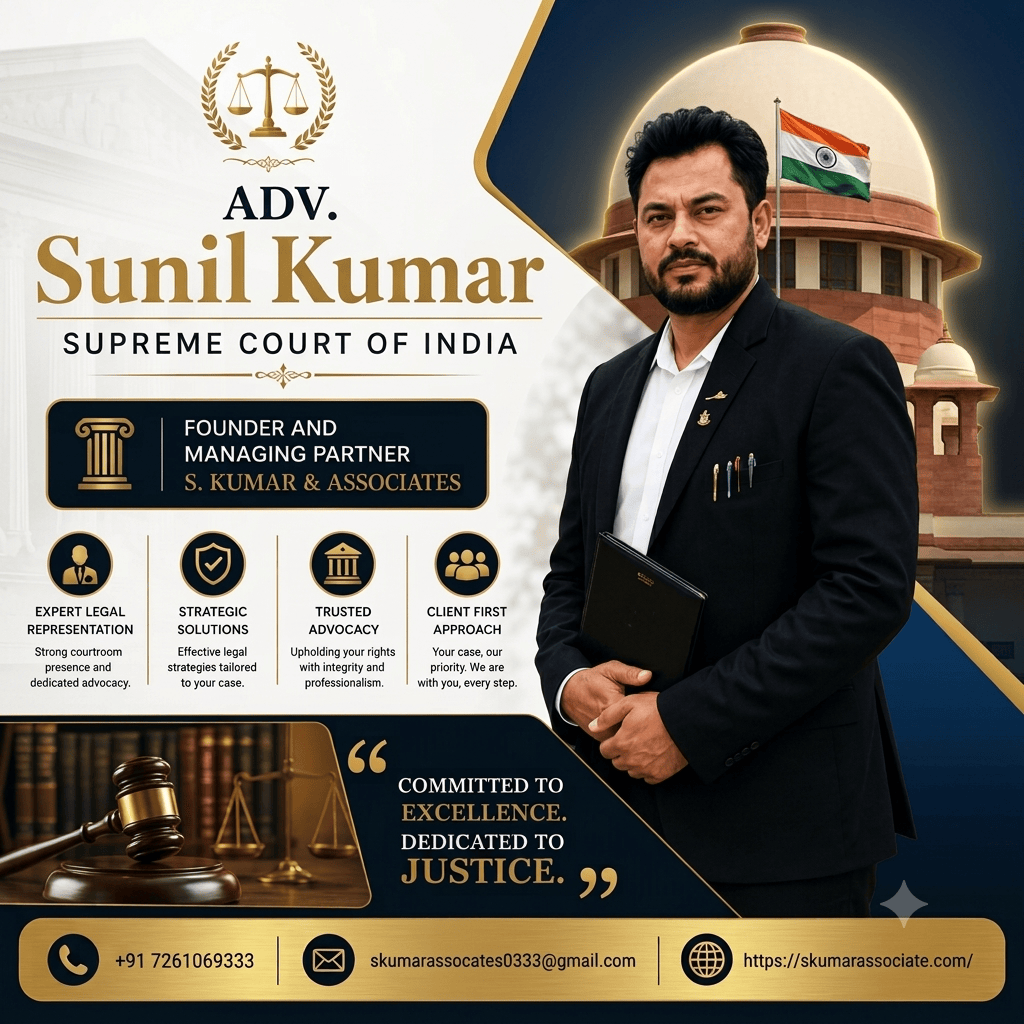
Advocate in Sector 26, Greater Noida for Property Allotment, YEIDA Disputes, Possession & Civil Litigation | Adv. Sunil Kumar (Helpline: +91 7261069333)
Advocate in Sector 26, Greater Noida – Property, Allotment and Civil Legal Matters
Property transactions and real estate disputes require careful examination of ownership documents, allotment conditions, payment records, and the legal status of the land. In Sector 26, Greater Noida, property-related concerns may involve development-authority allotments, group housing projects, possession, lease conditions, outstanding dues, construction rights and disputes between developers, authorities and other stakeholders. Before purchasing, transferring, developing or litigating over a property, it is important to understand the applicable documents and legal procedures.
Advocate Sunil Kumar, Supreme Court of India, High Court, Civil Court, Founder & Managing Partner of S. Kumar & Associates (Ph. +91 7261069333), provides legal assistance and representation in property-related matters, civil disputes, contractual issues and other litigation, subject to the facts of the matter, applicable law and professional engagement. Legal support may include reviewing documents, explaining available remedies, preparing notices and pleadings, and representing clients before the appropriate court or authority where engaged.
Whether you are a property owner, allottee, homebuyer, investor, developer, or a party involved in a land-related dispute, a document-based legal assessment can help identify the issues that need to be addressed before taking the next step.
Understanding Property Matters in Sector 26, Greater Noida
Sector 26 has been associated with a significant group-housing plot dispute involving the Yamuna Expressway Industrial Development Authority (YEIDA) and a developer. The dispute illustrates why an allotment letter or possession certificate should not be considered in isolation when assessing a property matter.
Depending on the particular property and transaction, legal questions may arise regarding:
The original allotment and its continuing validity.
Compliance with payment schedules and contractual conditions.
Physical possession versus documentary possession.
Cancellation of allotment and recovery of outstanding dues.
Lease deeds, transfer conditions and development obligations.
The status of land occupied or used by third parties.
Remedies available to an allottee, developer or affected landowner.
These issues are not identical in every property transaction. The authority concerned, the nature of the allotment, the contractual terms and the relevant orders must be examined separately.
Legal Assistance for YEIDA Allotment and Property Disputes
Where a property falls within the relevant YEIDA area, the allotment documents and applicable authority regulations can play an important role in determining the parties’ rights and obligations. A legal review may involve examining the allotment letter, lease deed, payment ledger, possession documents, correspondence, cancellation notices and subsequent orders.
1. Allotment and Cancellation Matters
Disputes can arise when an authority or developer alleges non-payment, breach of allotment conditions, non-compliance with development obligations or failure to meet a contractual deadline. The affected party may need to review the grounds for cancellation, the notice procedure, the calculation of dues and the remedies available under the applicable rules and agreement.
A challenge to cancellation must be assessed on its own facts. Not every cancellation is unlawful, and not every demand issued by an authority is automatically invalid.
2. Possession and Site-Related Disputes
A property file may contain a possession letter or certificate, while the actual site may remain inaccessible, occupied, or subject to competing claims. In such situations, the legal assessment should distinguish between documentary possession, physical possession and the obligations imposed by the allotment or lease documents.
Relevant records may include site inspection reports, demarcation documents, authority correspondence, revenue records and previous court orders.
3. Outstanding Dues and Contractual Obligations
Premium, instalments, lease rent, interest, extension charges and other demands should be checked against the applicable allotment terms and the authority’s calculations. Where a demand is disputed, the supporting documents and any available statutory or contractual remedy should be examined before deciding whether to submit a representation, pursue an appeal or initiate litigation.
4. Transfer, Lease and Development Conditions
Property transfers involving authority-allotted land may be subject to specific permission requirements, transfer charges or lease conditions. Before signing a sale agreement or accepting consideration, parties should establish whether the proposed transfer is legally permissible and whether any dues, restrictions or approvals remain outstanding.
Property Title Verification Before Buying or Investing
A property purchase can involve substantial financial commitments. Buyers should not rely solely on advertisements, informal assurances, photocopies of selected papers or a seller’s statement that the property is dispute-free.
A property due diligence exercise may include the following checks, depending on the nature of the land:
Ownership and title chain: Review the available sale deeds, conveyance deeds, lease deeds, allotment records and earlier transfers.
Authority records: Check the relevant authority’s allotment status, transfer permissions, lease conditions, and outstanding dues where applicable.
Revenue documents: Examine relevant khasra, khatauni, mutation and other revenue records when relevant to the property.
Encumbrances and competing claims: Investigate available information about mortgages, charges, competing transfers, litigation or other recorded interests.
Possession and boundaries: Compare the documentary description with the actual site, measurements and demarcation records.
Approvals and land use: Verify applicable land-use restrictions, sanctioned plans and building permissions.
Transaction documents: Review the proposed agreement, payment schedule, default provisions, refund conditions and registration requirements.
Mutation or an entry in a revenue record should not automatically be treated as conclusive proof of title. Likewise, registration of a document does not necessarily resolve every underlying ownership or encumbrance issue. The legal effect of each record depends on the applicable law and the circumstances.
Land Acquisition, Compensation and Rehabilitation
Land acquisition matters may involve compensation calculations, possession, rehabilitation, resettlement and disputes concerning the land taken by a public authority. Such matters require attention to the acquisition notification, award, land records, payment details and applicable statutory procedures.
Depending on the case, legal assistance may include reviewing acquisition documents, assessing whether the compensation calculation requires scrutiny, preparing a representation or identifying the appropriate statutory forum. Limitation periods and procedural requirements should be checked promptly.
A judgment concerning one acquisition project or group of landowners does not automatically decide the rights of every other landowner. Each claim must be assessed in light of its own acquisition records, applicable law and relevant court orders.
Civil Litigation and Contractual Disputes
Property disagreements can develop into civil litigation when negotiations or administrative representations do not resolve the matter. The appropriate remedy depends on the nature of the dispute, the relief sought, the parties involved, and the jurisdiction of the relevant forum.
Possible issues include:
Disputes over ownership, title or possession.
Breach of a sale agreement or other property contract.
Recovery of money or contractual dues.
Disputes relating to cancellation or termination.
Injunctions concerning threatened interference with property rights.
Disputes over boundaries, access or competing claims.
Enforcement or interpretation of contractual obligations.
A civil claim requires careful drafting of the facts, identification of the necessary parties, supporting documents, and a clear statement of the relief sought. Interim relief is not automatic; the court considers the applicable legal tests and the evidence placed before it.
Developer and Homebuyer Disputes
Homebuyers and developers may disagree over possession dates, construction obligations, registration, additional demands, cancellation, refund or other contractual terms. The appropriate legal route depends on whether the project and transaction fall within the jurisdiction of a particular statutory authority, consumer forum, real estate regulator or civil court.
Before proceeding, the following should be examined:
The builder-buyer agreement or allotment document.
The payment history and receipts.
Correspondence regarding possession, construction and registration.
Any demand, cancellation or termination notice.
The project's applicable approvals and regulatory status.
The limitation period and available forum.
The existence of a dispute does not by itself establish liability on either side. The contract, records and applicable law determine the available remedies.
Legal Notices, Documentation and Representation
A properly prepared legal notice or representation should set out the relevant facts, identify the documents relied upon and clearly state the requested remedy. General allegations or unsupported demands may not adequately address the actual dispute.
Legal assistance may include reviewing the file, organising supporting documents, preparing a response to a notice, drafting a representation to an authority, assessing the possibility of settlement and preparing pleadings where litigation is appropriate.
Where proceedings are already pending, earlier orders, filing dates and compliance requirements should be reviewed before taking further steps. Parties should retain copies of all applications, acknowledgements, notices, orders and payment records.
Recent Legal Update: Allahabad High Court Examines a Sector 26 Group-Housing Dispute
In September 2025, a report concerning a YEIDA group-housing plot in Sector 26 described proceedings involving SDS Housing and the authority. The dispute concerned whether physical possession had actually been delivered and the cancellation of the developer’s allotment.
According to the report, the developer had argued that it had not obtained actual possession despite substantial payments, while YEIDA relied on a possession certificate and raised concerns regarding unpaid dues. The Allahabad High Court appointed a commissioner to inspect the site and report on its status. The report also described the wider history of the allotment and the developer’s challenge to the cancellation.
Why this matters: The dispute highlights the importance of distinguishing between an authority’s possession record and the factual condition of a site. It also shows why payment obligations, allotment terms, cancellation proceedings and site evidence need to be examined together.
This report concerns a specific dispute and should not be interpreted as a final ruling that resolves every issue relating to Sector 26 or establishes the rights of unrelated property owners. The current procedural status and any later orders should be verified from the official court record before relying on the matter.
How to Prepare for a Property-Law Consultation
Before seeking legal assistance for a Sector 26 property matter, organise the documents relevant to your particular concern. The complete set will depend on whether the issue involves purchase, allotment, possession, cancellation, acquisition or litigation.
A useful starting file may include:
Identity and transaction details of the parties.
Allotment letter, agreement, sale deed or lease deed.
Payment receipts and account statements.
Authority notices and written responses.
Possession letters, site reports, and demarcation records.
Revenue documents and available title records.
Previous legal notices, case numbers and court orders.
Do not alter original documents or rely exclusively on edited screenshots. Keep the originals secure and provide complete, legible copies for review. If a deadline, hearing or notice-response period is approaching, mention the date at the outset so that urgency can be assessed.
Why a Document-Based Legal Assessment Matters
Property disputes often involve overlapping contractual, statutory and factual questions. A legal assessment should identify what is established by the available documents, what remains disputed and what additional records may be needed.
The assessment should also consider the appropriate forum, limitation, the relief that can lawfully be sought and the possible procedural consequences of each option. No lawyer can responsibly guarantee a particular court outcome in advance; the result depends on the facts, evidence, applicable law and decisions of the competent forum.
Contact Advocate Sunil Kumar
For legal assistance concerning property allotment, title verification, possession disputes, land matters, contractual disagreements, and civil litigation related to Sector 26, Greater Noida, you may contact:
Advocate Sunil Kumar Founder & Managing Partner – S. Kumar & Associates Supreme Court of India · Delhi High Court · Patna High Court Helpline: +91 7261069333 Email: [email protected] Website: https://skumarassociate.com/
The nature and scope of professional engagement, the appropriate forum, and the available remedy will be determined after reviewing the relevant facts and documents.
Frequently Asked Questions
1. Can an advocate assist with a YEIDA property allotment dispute in Sector 26?
Legal assistance may include reviewing allotment terms, payment records, possession documents, cancellation notices, and authority correspondence. The available remedy depends on the applicable rules, contractual conditions, and case history.
2. What should I check before buying a property in Sector 26, Greater Noida?
Check the ownership chain, allotment or lease conditions, transfer permissions, outstanding dues, encumbrances, possession, boundaries, and applicable approvals. The checks required will depend on the type of property and the nature of the proposed transaction.
3. Is a possession certificate sufficient to settle every possession dispute?
Not necessarily. Its legal significance depends on the relevant documents and circumstances. If physical possession is disputed, site records, inspection reports, correspondence and applicable court orders may also need to be examined.
4. What can I do if an authority cancels a property allotment?
Review the cancellation order, notice procedure, payment history, allotment conditions and available statutory or contractual remedies. Applicable deadlines should be checked immediately, because the correct procedure varies with the nature of the order.
5. Can I challenge a property-related demand for interest or other charges?
A demand may be examined against the allotment terms, applicable regulations, payment history, and relevant orders. Whether it can be challenged successfully depends on the facts and the legal basis of the demand.
6. Which documents are required for a property dispute consultation?
Common documents include the allotment letter or deed, agreement, payment receipts, possession records, notices, authority correspondence, revenue documents, and previous court orders. Additional records may be necessary depending on the issue.
7. Does mutation establish ownership of land?
Mutation is generally a revenue-record process and should not automatically be treated as conclusive proof of title. Ownership must be assessed using the relevant title documents, applicable law and other evidence.
8. Can a property dispute be resolved without filing a court case?
Some disputes may be addressed through negotiation, a written representation, contractual procedures or an appropriate authority or statutory forum. Whether an out-of-court route is suitable depends on the dispute and the remedy required.
Legal Disclaimer
This webpage is intended solely for general legal information and educational purposes. It does not constitute legal advice, a legal opinion on any specific case, a solicitation of professional work or a guarantee of any outcome. The information is not a substitute for an individual assessment of the relevant documents and facts. Legal rights and remedies depend on the applicable law, jurisdiction, limitation periods, evidence, contractual terms and orders of competent authorities or courts. Property records, allotment status, approvals and litigation history should be independently verified from the appropriate original or official sources. A professional engagement, if any, is subject to separate consultation and agreement.
🌍 IT NEWS — International Trending News
Breaking News | World Affairs | India | Technology | Business | Legal Updates | Fact-Check
Verified information. Responsible reporting. Global perspective.
Stay Informed. Stay Aware. Stay Ahead.
Advocate Sunil Kumar | Supreme Court of India
Founder & Managing Partner — S. Kumar & Associates
Legal consultation, litigation, legal research, case analysis, and legal awareness.
Helpline: +91 7261069333
Website: https://skumarassociate.com/
More Visit: https://advocatesunilkumarsupremecourtofindia.com/