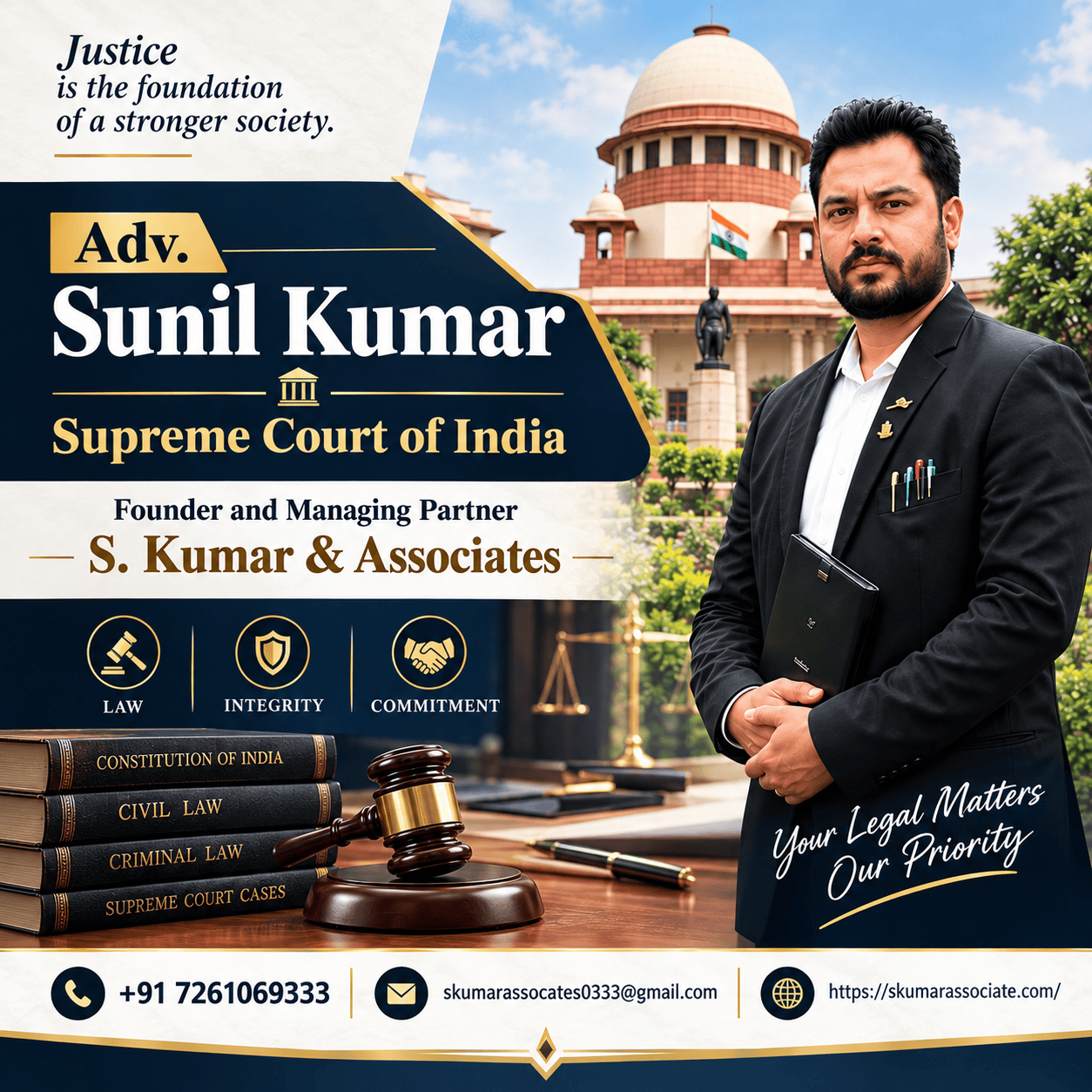
Advocate in Dwarka, South West Delhi for Apartment Ownership, Builder-Buyer Agreements, & Civil Litigation | Adv. Sunil Kumar (Helpline: +91 7261069333)
Dwarka, South West Delhi, is a major residential and commercial area where individuals, families, property owners, landlords, tenants, and businesses may encounter legal matters involving property transactions, apartment ownership, builder-buyer agreements, tenancy, inheritance, civil litigation, family disputes, criminal allegations, and commercial contracts. Property purchases, housing society disagreements, unpaid dues, contractual obligations, and disputes over ownership or possession can raise important legal questions. Understanding the relevant law, reviewing the available documents, and identifying the appropriate legal procedure are important steps when addressing such matters.
Advocate Sunil Kumar, Supreme Court of India, High Court, Civil Court, Founder & Managing Partner of S. Kumar & Associates (Ph. +91 7261069333), provides legal assistance concerning civil, property, criminal, family, commercial, and other legal matters, subject to the nature of the case and applicable jurisdiction. Individuals and businesses connected with Dwarka, South West Delhi, may require assistance with property document review, apartment-related disputes, legal notices, builder-buyer matters, rental agreements, inheritance claims, contractual disagreements, and court proceedings. Each case requires an individual assessment of the facts, supporting documents, applicable law, and procedural requirements.
Property Lawyer in Dwarka, South West Delhi
Property matters in Dwarka may concern apartments, residential houses, plots, commercial units, leases, transfers, or inherited property. Disputes can arise during the purchase or sale of a property, when possession is delayed, when ownership documents are questioned, or when parties disagree over contractual obligations.
Property-related legal assistance may include:
Reviewing sale deeds and ownership documents.
Examining builder-buyer agreements and allotment letters.
Assessing title, possession, and ownership disputes.
Reviewing apartment and housing society-related documents.
Examining lease agreements and tenancy disputes.
Reviewing inheritance and partition matters.
Preparing or responding to legal notices.
Evaluating civil remedies and possible injunctions.
Assessing disputes involving payments, transfers, and contractual obligations.
The appropriate legal approach depends on the documents, transaction history, nature of the property, and rights of the parties involved. Before initiating proceedings, it is important to understand the relevant law, competent forum, limitation period, and relief that may legally be available.
Apartment Ownership and Housing Society Disputes
Apartment owners may face disagreements concerning maintenance charges, common areas, parking arrangements, repairs, access, association decisions, or obligations under applicable agreements and rules. Some disputes involve individual owners and builders, while others concern the responsibilities of an apartment association or maintenance agency.
Depending on the circumstances, relevant issues may include:
Disputed maintenance charges or outstanding dues.
Use and management of common areas.
Parking allocation and related contractual rights.
Delayed or incomplete maintenance services.
Interpretation of apartment-related agreements.
Disputes over possession or promised facilities.
Compliance with applicable apartment, society, or regulatory provisions.
The legal position depends on the governing documents, applicable legislation, contractual terms, and the status of the parties involved. Before making a claim or withholding payment, owners should review the relevant agreement, invoices, notices, association rules, and available correspondence.
Advocate Sunil Kumar, Supreme Court of India | Helpline: +91 7261069333
Property Title Verification and Due Diligence
Before purchasing, selling, or accepting a transfer of property in Dwarka, it is prudent to examine the available ownership documents and transaction records. Due diligence can help identify inconsistencies, missing documents, possible restrictions, or claims that require further investigation.
Depending on the property and transaction, the review may include:
Registered sale deed or conveyance documents.
Previous title records and ownership history.
Allotment letters and builder-buyer agreements.
Payment receipts and possession documents.
Available encumbrance or charge-related records.
Property tax and relevant municipal records.
Approved building plans and applicable permissions.
Power of attorney documents, where relevant.
Leasehold or freehold conversion documents, where applicable.
Relevant housing society or apartment records.
Existing litigation, notices, or disclosed third-party claims.
Where a property is leasehold or subject to specific allotment conditions, transfer restrictions and permission requirements may need particular attention. The legal position should be assessed from the actual documents rather than assumptions about the property category.
Mutation and municipal records may provide relevant information, but they do not necessarily establish conclusive ownership by themselves. A title review can help identify risks but cannot guarantee that every possible defect or future dispute will be discovered.
Sale Deeds, Registration and Property Transfers
A property transaction should clearly identify the parties, accurately describe the premises, specify the consideration, and set out payment, possession, and completion terms. Applicable stamp duty, registration requirements, and transfer formalities should also be considered.
Legal review may involve examining a draft sale deed, checking the supporting documents, reviewing the seller's authority to transfer the property, and identifying unclear contractual terms.
Disputes can arise where a seller refuses to complete an agreement, a buyer alleges misrepresentation, payment remains outstanding, or possession is withheld. Depending on the agreement and circumstances, a legal notice, contractual remedy, or civil proceeding may be considered.
The availability of a remedy depends on the terms of the transaction, supporting evidence, limitation requirements, and applicable law. Parties should obtain an assessment before cancelling an agreement or taking steps that may affect their legal rights.
Builder-Buyer Disputes and RERA Matters
Property buyers may encounter disputes involving delayed possession, construction defects, changes in promised specifications, refund requests, disputed charges, or alleged breach of a builder-buyer agreement.
Depending on the project, transaction, and relief sought, possible legal routes may include a complaint before the relevant Real Estate Regulatory Authority, proceedings before a consumer commission, arbitration where legally applicable, or another competent forum. These options are subject to different jurisdictional and procedural requirements.
Documents that may be important include the allotment letter, builder-buyer agreement, payment receipts, possession offer, project disclosures, correspondence, and records of any earlier complaint or order.
Before filing a complaint, it is important to identify the nature of the claim, applicable statutory provisions, limitation period, and competent forum. The availability of a refund, compensation, possession order, or other relief depends on the facts and law.
Landlord-Tenant and Rental Disputes in Dwarka
Residential and commercial rental arrangements may give rise to disagreements concerning rent, security deposits, maintenance, termination, possession, or compliance with contractual conditions.
Legal issues may include:
Recovery or adjustment of security deposits.
Unpaid rent and other contractual dues.
Termination or expiry of a tenancy.
Eviction and possession proceedings under applicable law.
Disputes over maintenance and repairs.
Alleged unauthorised subletting.
Commercial lease interpretation and renewal.
Disputes concerning the use of rented premises.
Landlords and tenants should retain copies of agreements, payment records, notices, and relevant communications. The applicable legal process depends on the premises, tenancy arrangement, governing law, and relief sought. A landlord should not assume that forceful removal of an occupant can replace lawful procedure.
Advocate Sunil Kumar, Supreme Court of India | Helpline: +91 7261069333
Inheritance, Succession and Partition of Property
Family property disputes may arise after the death of an owner, when relatives disagree over their respective shares, or when a will or earlier transfer is questioned. Such matters may involve residential apartments, houses, plots, or other assets.
Legal issues may include:
Reviewing wills and succession-related documents.
Determining the applicable succession law.
Examining the nature and ownership history of the property.
Assessing the rights of legal heirs and co-owners.
Reviewing previous transfers or relinquishment documents.
Preparing or reviewing family settlements.
Considering partition or declaration proceedings.
A person's share cannot be determined solely by their relationship to the former owner. The legal position may depend on whether the property is self-acquired or ancestral/coparcenary property, the applicable personal law, the existence and validity of a will, prior transfers, and other relevant circumstances.
Where possible, a properly documented settlement may help resolve a disagreement. If settlement is not possible, a suitable legal proceeding may be considered after reviewing the available evidence and applicable law.
Civil Litigation and Legal Notice Services
A legal notice may communicate a claim, identify an alleged breach, request compliance, or create a written record of a dispute. However, a notice is not mandatory for every legal proceeding, and its legal effect depends on the circumstances and applicable law.
Civil litigation may concern property ownership, possession, contractual performance, recovery of money, injunctions, declarations, or other remedies available under law.
Before sending or responding to a notice, the relevant agreement, payment records, correspondence, dates, and requested relief should be reviewed. Limitation periods, jurisdiction, court fees, and procedural requirements should also be considered before filing a case.
Where appropriate, negotiation or mediation may help the parties resolve some issues without prolonged litigation. If a settlement cannot be reached, the available legal remedies should be evaluated on their merits.
Criminal Law and Police-Related Matters
Legal concerns may also arise from allegations of cheating, forgery, criminal intimidation, assault, breach of trust, or other offences. A property or financial disagreement does not automatically establish a criminal offence; the relevant legal ingredients and supporting evidence must be assessed.
Depending on the circumstances, assistance may involve reviewing a complaint or notice, organising documentary evidence, preparing a factual response, understanding procedural options, or considering appropriate remedies before a competent authority or court.
Individuals should preserve relevant agreements, transaction records, messages, notices, and other evidence. Where a matter involves an urgent court deadline, arrest-related concern, or police procedure, timely case-specific legal advice may be important.
Family and Matrimonial Legal Matters
Family disputes may involve divorce, judicial separation, maintenance, child custody, visitation, domestic violence proceedings, or disagreements concerning jointly held property. The applicable legal framework and available remedies depend on the facts, the parties' circumstances, and the stage of the proceedings.
Legal assistance may include reviewing documents, explaining procedural requirements, preparing or responding to pleadings, and considering negotiation or mediation where suitable. In matters involving children, decisions concerning custody and visitation are governed by applicable law and the child's welfare.
Every family matter should be assessed individually. The legal outcome depends on the evidence, relevant law, and decision of the competent court or authority.
Advocate Sunil Kumar, Supreme Court of India | Helpline: +91 7261069333
Commercial Disputes and Recovery of Money
Businesses, shopkeepers, professionals, service providers, and property owners may encounter disputes involving unpaid invoices, contractual obligations, leases, security deposits, or incomplete performance of an agreement.
Commercial legal matters may include:
Recovery of outstanding payments.
Breach of a commercial contract.
Disputes involving shop and office leases.
Security deposit recovery.
Contract termination and interpretation.
Cheque dishonour proceedings where statutory conditions are satisfied.
Arbitration and contractual dispute-resolution procedures.
Claims involving delayed or incomplete performance.
The legal approach should be based on the contract, transaction history, supporting evidence, limitation period, and competent forum. A claim should be assessed before proceedings are initiated.
Legal Assistance for Matters in Dwarka
When considering legal assistance for a matter connected with Dwarka, South West Delhi, individuals should look for clear explanations of the applicable law, documents required, available procedures, fee arrangements, and practical limitations.
Advocate Sunil Kumar, Founder & Managing Partner of S. Kumar & Associates, handles legal matters within the scope of applicable professional practice and jurisdiction. Depending on the issue, an assessment may involve reviewing documents, understanding the sequence of events, identifying legal questions, and considering whether a notice, negotiation, regulatory complaint, or court proceeding may be appropriate.
Before seeking an assessment, organise a short chronology of events and copies of the relevant agreements, deeds, notices, payment records, correspondence, and previous orders. Keep original documents secure and share sensitive information only through suitable channels.
Contact Details — S. Kumar & Associates
S. KUMAR & ASSOCIATES Advocates · Solicitors · Law Firm
Advocate Sunil Kumar Supreme Court of India · Delhi High Court · Patna High Court Founder & Managing Partner — S. Kumar & Associates
Helpline: +91 7261069333 Website: https://skumarassociate.com/
For legal matters in Dwarka, South West Delhi, the right approach depends on the facts, documents, jurisdiction, and relief sought.
Frequently Asked Questions
1. Can I seek legal assistance for a property dispute in Dwarka?
Legal assistance may help with ownership claims, sale agreements, possession, apartment-related disputes, tenancy, inheritance, and other property matters. The appropriate remedy depends on the facts, documents, and applicable law.
2. What documents should I check before purchasing an apartment in Dwarka?
Depending on the property, relevant documents may include the title or conveyance deed, allotment letter, builder-buyer agreement, payment receipts, possession documents, applicable permissions, and available encumbrance records. Leasehold or transfer restrictions should also be examined where relevant.
3. What can I do if a builder delays possession?
Review the agreement, payment records, promised possession date, correspondence, and applicable project information. Depending on the circumstances, a complaint before RERA, a consumer commission, or another competent forum may be considered.
4. Can an apartment owner challenge disputed maintenance charges?
The available options depend on the governing documents, applicable rules, basis of the charges, and the records maintained by the relevant association or agency. The agreement, invoices, notices, and correspondence should be reviewed.
5. Can a landlord evict a tenant without following legal procedure?
A landlord should follow the applicable tenancy law and lawful process. The rights of the parties depend on the tenancy arrangement, premises, and relevant legal provisions.
6. How are inherited property shares determined?
Shares depend on the applicable succession law, nature of the property, ownership documents, any valid will, previous transfers, and other relevant facts. A document-based assessment is necessary.
7. Can a legal notice resolve a property or commercial dispute?
A notice may encourage compliance or settlement, but it does not guarantee resolution. If the dispute remains unresolved, an appropriate legal proceeding may be considered where available.
8. How can I contact Advocate Sunil Kumar?
You can call +91 7261069333 or visit https://skumarassociate.com/ for information about S. Kumar & Associates. The suitability and availability of assistance depend on the nature of the matter and applicable professional requirements.
Legal Disclaimer
This page is provided for general informational and educational purposes only. It does not constitute legal advice, create an advocate-client relationship, or replace an assessment based on the specific facts and documents of a case. No outcome or result is guaranteed. Legal rights, available remedies, jurisdiction, limitation periods, and procedural requirements depend on the circumstances and applicable law. Readers should obtain case-specific advice before taking legal action.
This content is not intended as solicitation or advertising prohibited by the Advocates Act, 1961, the Bar Council of India Rules, or applicable professional-conduct requirements. References to legal services are informational only.
🌍 IT NEWS — International Trending News
Breaking News | World Affairs | India | Technology | Business | Legal Updates | Fact-Check
Verified information. Responsible reporting. Global perspective.
🌐 https://skumarassociate.com/news/hi
Stay Informed. Stay Aware. Stay Ahead.
Advocate Sunil Kumar | Supreme Court of India
Founder & Managing Partner — S. Kumar & Associates
Legal consultation, litigation, legal research, case analysis, and legal awareness.
Helpline: +91 7261069333
Website: https://skumarassociate.com/
More Visit: https://advocatesunilkumarsupremecourtofindia.com/
YouTube: https://youtube.com/@advocatesunilkumarsc
📸 Photos & Videos