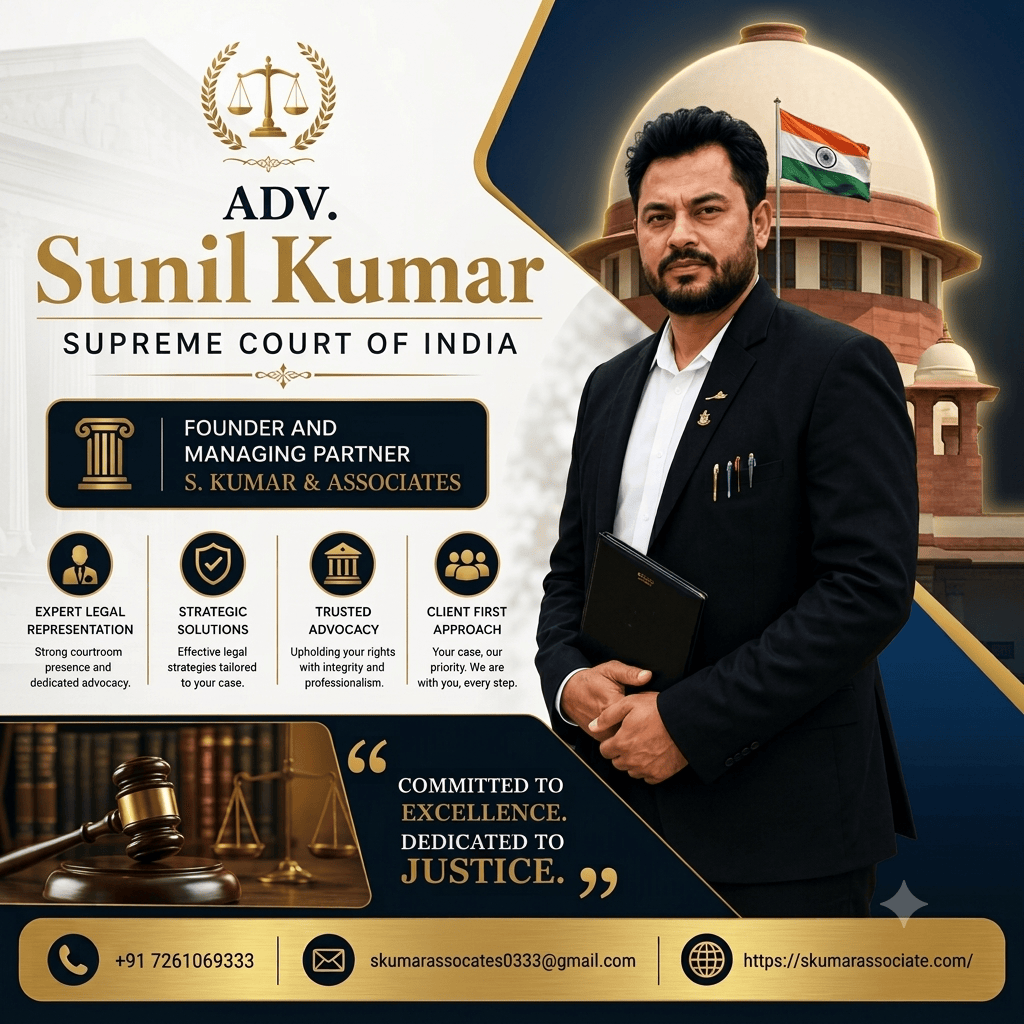
Advocate in Deoli, South Delhi for Property Ownership, Builder-Buyer Disputes, & Civil Litigation| Adv. Sunil Kumar (Helpline: +91 7261069333)
Deoli is a locality in South Delhi where residents, property owners, tenants, homebuyers, landlords, and business operators may encounter legal issues involving property ownership, land records, sale and purchase agreements, inheritance, tenancy, builder-buyer disputes, and civil litigation. Property-related transactions require particular attention to ownership documents, registration records, possession, contractual obligations, and applicable local regulations. When a disagreement arises, understanding the available legal remedies and following the correct procedure can help parties make informed decisions.
Advocate Sunil Kumar, Supreme Court of India, High Court, Civil Court, Founder & Managing Partner of S. Kumar & Associates (Ph. +91 7261069333), provides legal assistance relating to property disputes, civil litigation, documentation, family matters, criminal law, commercial disputes and other legal proceedings, subject to the facts of each matter and applicable law. Individuals and businesses connected with Deoli and other parts of South Delhi may seek guidance regarding document review, legal notices, court procedures, property-related claims and the remedies available under the relevant legal framework.
Property Advocate in Deoli, South Delhi
Property disputes can involve ownership claims, incomplete documentation, disagreements between co-owners, disputed transfers, unauthorised occupation or uncertainty regarding the rights of a purchaser or seller. Before entering into a property transaction or initiating legal proceedings, it is important to understand the nature of the property, review the available records and identify any existing legal complications.
Legal assistance may be relevant to matters involving:
Residential plots, houses, flats and commercial premises.
Sale deeds, agreements to sell and conveyance documents.
Ownership and title verification.
Property partition and inheritance disputes.
Encroachment, boundary and possession disagreements.
Landlord-tenant disputes and unpaid rent.
Builder-buyer disagreements and delayed possession.
Property-related injunctions and civil suits.
Recovery of money arising from property transactions.
Disputes concerning contractual obligations and transfer of ownership.
The correct legal remedy depends on the property's documentation, the rights claimed by each party, the applicable law, and the jurisdiction of the competent court or authority.
Advocate Sunil Kumar, Supreme Court of India | Helpline: +91 7261069333
Property Title Verification and Due Diligence
Property buyers should not rely exclusively on verbal assurances, possession, or a single document when assessing ownership. A proper review of the available title records and transaction history can help identify inconsistencies and potential risks before a purchase is completed.
For a property connected with Deoli, South Delhi, the review may include the following documents, where applicable:
Registered sale deed or conveyance deed.
Previous title documents establishing the ownership chain.
Agreement to sell and payment receipts.
Registration and stamp-duty records.
Available encumbrance-related information.
Mutation and municipal property-tax records.
Approved building plans and relevant permissions.
Allotment, leasehold or transfer documents, where applicable.
Court orders or litigation records affecting the property.
Documents concerning inheritance, succession or partition.
The legal significance of each document must be assessed in context. Mutation and property-tax entries, for example, are not necessarily conclusive proof of title. Likewise, the registration of a document does not automatically eliminate every possible ownership defect.
Advocate Sunil Kumar, Supreme Court of India | Helpline: +91 7261069333
Sale and Purchase of Property in Deoli
Property transactions involve financial and legal commitments that should be clearly documented. Disagreements may arise when a seller fails to complete a transaction, a buyer does not make the agreed payment, possession is delayed, or the parties interpret the agreement differently.
A legal review may address:
The terms and conditions of the agreement to sell.
Payment schedules and proof of consideration.
Obligations relating to execution and registration.
Conditions for cancellation and refund.
Representations concerning ownership and encumbrances.
Obligations relating to delivery of possession.
Remedies for breach of contractual terms.
Depending on the circumstances, a party may consider a claim for refund, damages, specific performance or another legally available remedy. The appropriate option depends on the agreement, supporting evidence, limitation periods and applicable law.
Land Records, Boundary Disputes and Encroachment
Disagreements involving boundaries, access, occupation and alleged encroachment may arise when neighbouring owners interpret property limits differently or when a party disputes another person's possession. In some cases, questions concerning the property's recorded description or the consistency of available plans may require closer examination.
Potential steps may include reviewing ownership documents, obtaining appropriate measurements or demarcation where available, documenting the alleged interference, and approaching the competent authority or court when legally justified.
Evidence may include property plans, photographs, correspondence, possession-related records and relevant official documents. The proper procedure depends on the nature of the property and the issue involved. Parties should avoid forcible eviction, demolition or other self-help measures without establishing a lawful basis.
Builder-Buyer Disputes and RERA Matters
Homebuyers may face disagreements over delayed possession, construction quality, changes to agreed specifications, cancellation charges, refunds, or failure to meet contractual obligations. The Real Estate (Regulation and Development) Act, 2016, may provide remedies where the project and dispute fall within its scope.
A preliminary assessment may consider:
The builder-buyer agreement.
Payment receipts and the agreed payment schedule.
Promised possession dates and contractual conditions.
Project registration and disclosures, where applicable.
Written communication regarding delays or defects.
The relief sought, such as possession, refund, or compensation.
Depending on the facts, the appropriate forum may be a RERA authority or tribunal, a consumer commission, a civil court or another competent forum. The choice requires an assessment of statutory coverage, jurisdiction and the remedies available.
Inheritance and Family Property Disputes
Inherited property can become the subject of disagreement when family members dispute ownership shares, the validity of a will, possession or the transfer of property. A person's entitlement cannot always be determined solely by family relationships or long-term occupation.
Relevant records may include title deeds, wills, succession documents, death certificates, family arrangements and other evidence concerning ownership. The applicable succession law and the legal status of each claimant must be examined before determining their rights.
Depending on the circumstances, the parties may consider negotiation, mediation, a properly documented family settlement, partition proceedings, or a declaration of rights before the competent court. A careful assessment can help identify the issues that need resolution and the documents required to support a claim.
Advocate Sunil Kumar, Supreme Court of India | Helpline: +91 7261069333
Landlord-Tenant Disputes in Deoli
Residential and commercial rental arrangements can lead to disagreements regarding rent, security deposits, maintenance, termination, property damage, or the return of possession. Both landlords and tenants should understand their contractual obligations and the legal procedure applicable to the particular tenancy.
Legal assistance may involve:
Reviewing rental, lease or leave-and-licence agreements.
Assessing outstanding rent and other contractual dues.
Preparing or responding to termination notices.
Examining disputes over security-deposit refunds.
Evaluating lawful procedures for eviction or recovery of possession.
Addressing alleged breaches of tenancy conditions.
The applicable framework depends on the terms of the agreement, the type of premises and relevant legislation. A landlord should not assume that changing locks, removing belongings or disconnecting essential services is a lawful substitute for following the required procedure.
Civil Litigation, Injunctions and Recovery Claims
Civil litigation may become necessary when negotiation fails to resolve a property or contractual dispute. Depending on the legal rights involved, a party may seek a declaration, injunction, possession, recovery of money, specific performance or other appropriate relief.
Before proceeding, it is important to assess the available evidence, the cause of action, limitation periods, territorial jurisdiction, court fees and procedural requirements. A legal notice may help communicate a demand or record a party's position, but it is not mandatory in every case and does not guarantee a settlement.
Where there is a risk of interference with property or a disputed transaction, a party may consider whether interim relief is legally available. Courts assess such requests under the applicable legal standards and the circumstances presented before them.
Criminal Law and Police-Related Matters
Some property or financial disagreements may involve allegations of cheating, forgery, criminal breach of trust, intimidation or other offences. However, a contractual disagreement does not automatically constitute a criminal offence. The facts must be examined to determine whether the necessary legal elements are present.
Legal assistance may include reviewing complaints, responding to police notices, assessing supporting evidence, preparing a factual representation or evaluating appropriate bail-related and procedural remedies. The available options depend on the allegations, the stage of proceedings, and the applicable criminal law.
Individuals should preserve relevant documents and communications and avoid altering evidence or making unsupported allegations.
Family and Matrimonial Legal Matters
Residents of Deoli and the wider South Delhi area may also require legal guidance regarding divorce, maintenance, child custody, visitation, domestic disputes or family financial arrangements. Such matters often involve personal circumstances as well as legal questions, making a careful assessment important.
Depending on the case, options may include mediation where appropriate, a negotiated settlement, filing or defending proceedings, or seeking interim relief. Matters concerning children require particular attention to their welfare and the applicable legal standards.
The appropriate approach depends on the parties' circumstances, the evidence and the relevant statutory framework. Any settlement should be voluntary, properly documented and legally sustainable.
Commercial Disputes and Recovery of Money
Business owners, service providers, contractors, landlords and other parties may face disputes involving unpaid invoices, breach of contract, security deposits, supply arrangements or non-performance of agreed obligations.
A preliminary review may include contracts, invoices, bank records, purchase orders, delivery acknowledgements and written communications. Depending on the nature of the dispute, potential routes may include negotiation, mediation, arbitration or proceedings before the competent court.
Special procedural mechanisms may be available for certain commercial claims, but their use depends on the applicable statutory conditions and the nature of the dispute. The value of a claim alone does not establish entitlement to a particular remedy.
Choosing Legal Assistance in Deoli, South Delhi
When considering legal assistance for a matter connected with Deoli, it is useful to identify the principal legal issue and organise the relevant documents before seeking an assessment. Clear documentation can help establish the transaction history, the parties' positions and the relief being considered.
Advocate Sunil Kumar and S. Kumar & Associates may be contacted to enquire about assistance with property disputes, civil proceedings, contractual issues, family matters and other legal concerns, subject to the nature of the matter and professional obligations.
An initial assessment may focus on:
Understanding the facts and identifying the legal issue.
Reviewing the available documents and supporting evidence.
Identifying the appropriate court, authority or forum.
Considering relevant limitation periods and procedural requirements.
Evaluating potential remedies and associated risks.
Assessing whether negotiation, mediation or litigation may be suitable.
No outcome can be guaranteed in advance. Every matter must be assessed on its own facts, evidence, applicable law, and the decisions of the competent authority or court.
Contact
S. KUMAR & ASSOCIATES Advocates · Solicitors · Law Firm
Advocate Sunil Kumar Supreme Court of India · Delhi High Court · Patna High Court Founder & Managing Partner — S. Kumar & Associates
Helpline: +91 7261069333 Website: https://skumarassociate.com/
Individuals, families, property owners, buyers, tenants and businesses connected with Deoli and South Delhi may use these contact details to enquire about legal assistance. Any engagement is subject to the details of the matter, professional availability, applicable jurisdiction, and agreed terms.
Frequently Asked Questions
1. How can I find an advocate for a property dispute in Deoli, South Delhi?
Begin by identifying the property issue, collecting the available ownership documents and determining what relief may be required. You may contact Advocate Sunil Kumar through the details listed above to enquire about assistance, subject to the facts of the matter and applicable professional requirements.
2. Which documents are important when buying property in Deoli?
Depending on the property, relevant documents may include the sale deed, previous title documents, registration records, payment receipts, available encumbrance information, municipal records, and required permissions. The specific documents depend on the property's legal status and transaction history.
3. What can I do if a seller refuses to complete a property transaction?
Possible remedies may include a claim for refund, damages, or specific performance, depending on the agreement, evidence, limitation period, and applicable law. The contract and payment records should be reviewed before selecting a remedy.
4. Can I take legal action against someone encroaching on my property?
Potential options may include a formal notice, an appropriate demarcation process, a complaint to the competent authority, or civil proceedings. The proper route depends on the ownership evidence, nature of the encroachment, and applicable law.
5. Can a homebuyer approach RERA for delayed possession?
A homebuyer may be able to seek relief under RERA if the project and dispute fall within the Act's scope and the statutory conditions are met. The agreement, project status, and requested remedy should be assessed before proceeding.
6. How can inherited property be divided among family members?
The available options may include a family settlement, mediation, partition proceedings, or another appropriate remedy. The applicable succession law, title documents, and legal rights of the family members must be examined.
7. Is a legal notice compulsory before filing a civil case?
A notice is required in certain circumstances but not in every civil dispute. The requirement depends on the type of claim, the parties involved, and applicable procedural law.
8. Can Advocate Sunil Kumar be contacted for legal matters connected with Deoli?
You may use the helpline +91 7261069333, website or email provided above to enquire about legal assistance for a matter connected with Deoli or elsewhere. Any engagement depends on the details of the case, professional availability and applicable jurisdiction.
Legal Disclaimer
This article is for general informational and educational purposes only. It does not constitute legal advice, create an advocate-client relationship, or replace an assessment of the facts and documents of an individual matter. Laws and procedures may change, and the availability of a remedy depends on the circumstances, evidence, and applicable law.
No particular result is promised or guaranteed. Readers should obtain independent legal advice appropriate to their circumstances before taking action. This content is not intended to solicit work or advertise professional services in a manner prohibited by the Advocates Act, 1961, the Bar Council of India Rules or applicable professional-conduct requirements.
🌍 IT NEWS — International Trending News
Breaking News | World Affairs | India | Technology | Business | Legal Updates | Fact-Check
Verified information. Responsible reporting. Global perspective.
🌐 https://skumarassociate.com/news/hi
Stay Informed. Stay Aware. Stay Ahead.
Advocate Sunil Kumar | Supreme Court of India
Founder & Managing Partner — S. Kumar & Associates
Legal consultation, litigation, legal research, case analysis, and legal awareness.
Helpline: +91 7261069333
Website: https://skumarassociate.com/
More Visit: https://advocatesunilkumarsupremecourtofindia.com/
YouTube: https://youtube.com/@advocatesunilkumarsc
📸 Photos & Videos